Browse more articles
Basement Bar Ideas: Pair a Bar with a Raised Theater Back Row
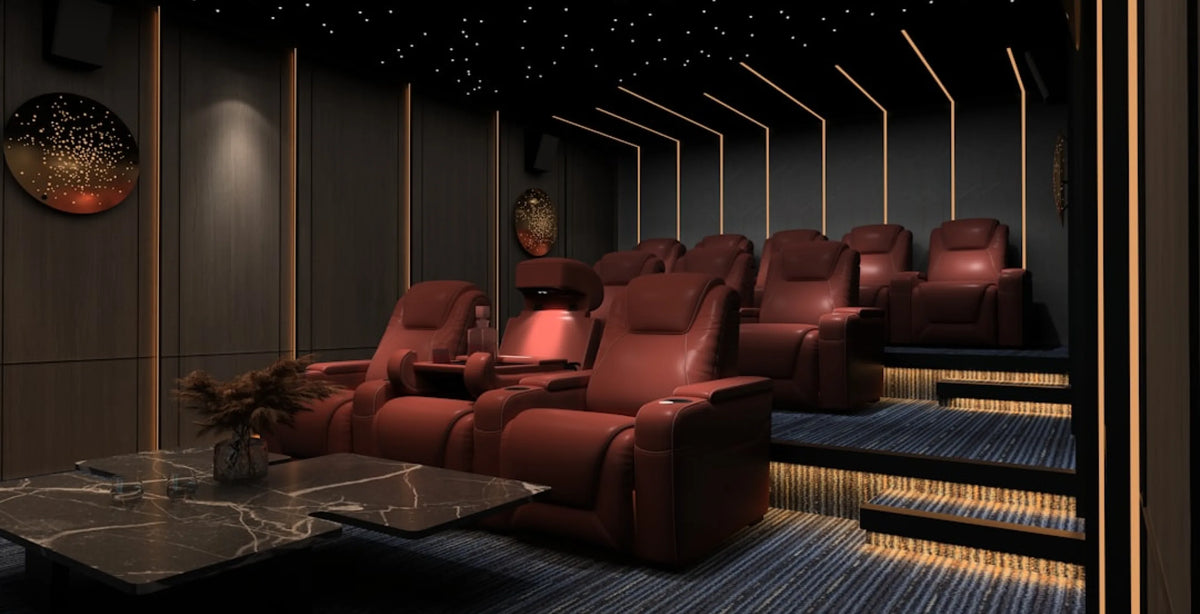
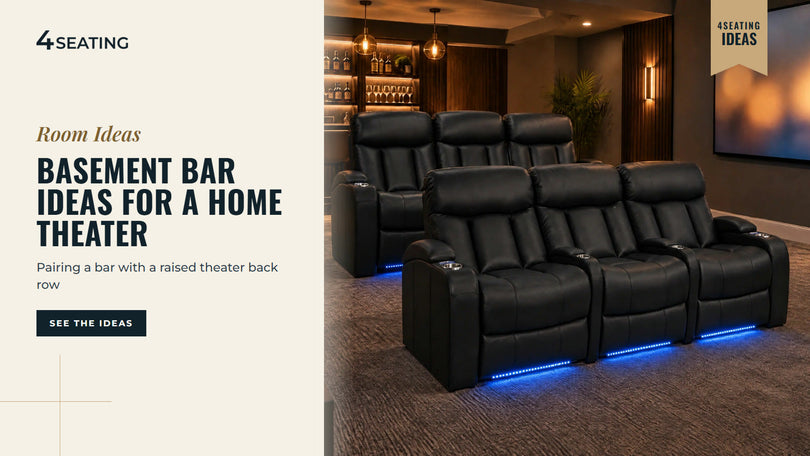
On game day in a finished basement, the screen's on, the back row is full, and somebody still needs a spot to set down a drink without blocking anyone's view. A basement bar and a home theater can share that back wall just fine. Here's the direct answer: a raised back row, a second row of theater seats built on a taller base, set behind the front row so the back seats keep their sightline. Add a bar ledge behind or beside that row and guests get a clear view and a place for a drink, with no riser platform required. Pick a basement bar idea from the 15 below, then check whether a raised back row or a riser fits your room better, and use the heights and clearances to plan a bar ledge behind seating that reclines. 4Seating's BACKROW theater seating collection is built for exactly this second-row spot. One thing worth clearing up first: BACKROW seating isn't bar stools, and it doesn't sit at bar level. It's a full theater recliner, recline, footrest, cupholders and all, just set on a taller seat base so a second row can see over the row in front without a separate riser. Bars, stools and counters are a separate category: an actual bar ledge behind the row gets built on site or bought separately, and the raised back row is the seating side of the plan. 15 Basement Bar Ideas, Including 5 Built Right Into the Theater Room Most basement bars fall into a handful of layouts, and the right one usually comes down to how much floor space you can spare and whether the room already doubles as your theater. Here are ten general basement bar concepts, followed by five ways to fold a bar into a home theater or media room specifically. General basement bar layouts: A straight bar along one wall, with wall-mounted shelving for glassware above. An L-shaped bar that wraps a corner, freeing up the rest of the room for lounge seating. A U-shaped bar facing three sides, for larger basements that can spare the footprint. A sunken bar area with a step down, which keeps the counter at a comfortable standing height. A peninsula bar that separates a game area from a lounge area without a full wall. A wet bar with a sink and mini fridge, tucked near existing basement plumbing. A dry bar with just a countertop, open shelving and a beverage cooler, no plumbing needed. A mobile bar cart, for a basement that also doubles as a guest room or gym. Built-in shelving with a floating counter, for a narrow wall that can't fit a full bar footprint. A rustic wood-and-stone finish bar, for a basement styled as a cabin or lodge room. Bar layouts built into the theater room: A bar ledge along the back wall, standing height, directly behind the last row of seats. A raised back row of theater seats, a BACKROW-style taller second row, so the back row keeps its sightline over the front row. A snack and drink shelf built into the wall next to a raised back row. A pass-through opening between a bar in an adjoining hallway or lobby and the theater room. A slim counter behind a two-row theater layout, sized to the depth of the back row. Layouts 11 through 15 are the ones this guide covers in detail, since they're where 4Seating's seating fits directly. The takeaway: pick a general layout first, then work out below whether a raised back row or a bar ledge, or both, suits your room. A Raised Back Row or a Riser: Which Fits a Two-Purpose Room? In a basement that's both a home theater and a bar or game-day space, a raised back row usually fits better than a riser platform, because the extra height comes from the seat itself rather than the floor. The Grenada Italian Leather BACKROW Theater Seating, for example, sits about 6.5" taller than the standard Grenada row, because the height is built into a taller seat base rather than a stage underneath. Check your front row's height before you plan sightlines. That keeps the floor behind the front row clear for a bar ledge, a snack table or extra standing room during a game-day crowd. A riser platform gets you the same raised sightline using seats you already own, but it adds a 7" or 14" platform to the room, and that platform takes up the same floor space a bar counter or wider walkway would otherwise use. If you're starting the back row from scratch, lean toward BACKROW. If you're keeping your current seats, or building a third row, a riser is the better route. Raised BACKROW back row Standard row on a riser Where the extra height comes from A taller seat base A 7" or 14" platform under the seats Floor space behind the front row Stays open for a bar ledge or walkway Taken up by the platform itself Works with seats you already own No, it's a new row Yes Best for A theater room doubling as a bar or game-day space Rebuilding a room around seats you're keeping, or a third row If you're leaning toward the riser side for a multi-row build, the riser platforms above have the specs you need. Browse our Home Theater Risers If you're starting the back row from scratch instead, the picks at the end of this guide (the Grenada and Rialto BACKROW rows, both wall-huggers) are built for this second-row spot. Browse our BACKROW Theater Seating A Bar Ledge Behind the Couch: Heights and Clearances to Plan Around If you're adding an actual bar counter or ledge instead of a raised back row, a common guideline is a bar counter at about 42" and a counter-height ledge at about 36". The stool follows from that: a bar stool is typically about 28 to 32" and a counter stool about 24 to 26", with the seat sitting roughly 10 to 12 inches below the surface so there's room for knees. Room to walk behind the stools matters just as much as the counter height itself. Leave a clear path behind seated stools, and check local code with your building department for any rules that apply to your space. If your bar sits directly behind a row of theater seats rather than stools, use the seat's own depth and recline clearance instead of a stool number. A wall-hugger is a recliner that needs only a few inches between the back of the seat and the wall to fully recline, and the Grenada and Rialto BACKROW rows each list 3" on their Specifications tabs. Other models vary, so check each product's Specifications tab. Setup Standing/counter height Seat height Bar counter ~42" about 28 to 32" bar stool Counter-height ledge ~36" about 24 to 26" counter stool BACKROW back row (no stool) N/A, full recliner Grenada BACKROW sits about 6.5" above the standard Grenada row; check your own front row's height Game-Day Setup: Seating, Sightlines and a Spot for Snacks A basement bar built for game days needs three things sorted before kickoff: enough seats for your usual crowd, a sightline each seat can actually use, and somewhere for drinks and snacks that isn't balanced on an armrest. Count seats the way you'd count a theater row, not a living room. BACKROW rows come in configurations from 2 to 5 seats, including loveseat options, so you can size the back row to match a 2-, 3- or 4-seat front row. Browse our Home Theater Seating For the sightline, the same logic that makes a raised back row work in a movie room applies on game day. Take the bottom third of the screen, right where the scoreboard or the game clock usually sits. A flat second row loses that strip behind the heads of the row in front. Raising the back row, whether with BACKROW seats or a riser, keeps it visible for the whole room, not just the front row. For snacks and drinks, keep the surface out of the walking lane. A shelf or ledge built into the wall behind the back row, or a small side table between seats, keeps cups and plates off the floor without adding a full-height bar counter if you don't want one. What a Basement Bar Project Tends to Cost You in Effort Basement bar projects span a wide range, and the biggest driver is almost always plumbing and finish level rather than size. A simple dry bar, a countertop, open shelving and a beverage cooler with no sink, sits at the lower end of that range. Add a sink, a dishwasher, custom cabinetry or stone countertops, and the project grows quickly, since now you're paying for plumbing work on top of carpentry and finishes. Get quotes from a local contractor for your layout before you set a budget. If you're weighing where to put your effort, the seating is worth prioritizing over bar finishes, since a plain countertop matters less than a back row with a good sightline. A raised BACKROW row skips a raised platform entirely, since the height is part of the seat, which frees up part of the project for the bar side of the room. Does a Basement Bar Add Value to a Home? That depends on your local market and on how finished the rest of the basement is, so a local real estate agent is the best person to ask. We don't have a figure to offer, so the safest approach is to build the bar for how you'll use the room. Common Basement Remodel Mistakes Common mistakes are skipping a moisture check, not planning enough outlets, and not measuring ceiling height before adding a raised row. In a bar-and-theater basement, that means skipping a moisture and waterproofing check before finishing walls and floors, not planning outlets for a bar's appliances and a theater's AV gear (each power recliner may need its own outlet, so have a licensed electrician plan them), and not measuring ceiling height before adding a raised back row or platform. Measure from the floor to your ceiling's tightest overhead point, such as a duct, beam, soffit or sprinkler head, before you commit to a riser height or a raised BACKROW row, so your tallest guest still has headroom. For everything else that goes into the room around the bar, layout, lighting, sound and seating for the whole space, see our companion guide, Basement Home Theater Ideas. Where to Start: 4Seating's Raised Back Row Picks A second row starts the way a front row does: by seat count. Grenada Italian Leather BACKROW Theater Seating - a wall-hugger row built for a second-row spot tight against a back wall, in rows of 2 to 5. Rialto BACKROW Theater Seating - a wall-hugger second-row build with power recline, in rows of 2 to 5. Swatches are available for many upholstery options. 4Seating covers shipping on every seat to anywhere in the continental US. Prefer to order by phone, or still have a question? Our customer help line can support you during business hours at 1-800-407-8665. About this guide: Since 1997, 4Seating has been selling home theater seating, including the back row seats covered here.
What Is a Wall Hugger Recliner? How Much Space You Need Behind Theater Seats
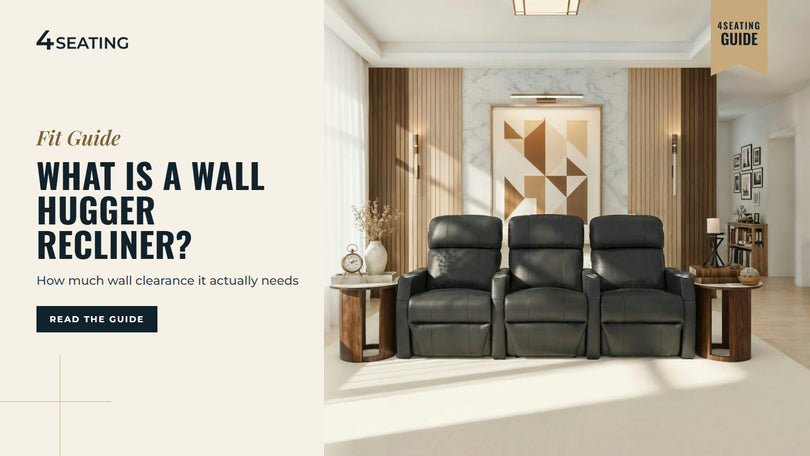
You've measured the room, and the back row has to sit close to the wall. Will a recliner even fully recline there? That's exactly the problem a wall hugger recliner solves. A wall hugger recliner, also called a wall saver or wall-away recliner, uses a forward-glide mechanism: instead of the backrest tilting backward into the room, the whole seat moves forward as you recline. That lets it sit much closer to a wall than a traditional recliner. Coming up: how the mechanism works, how much clearance to actually plan for, and how it's different from a spacesaver arm. It's the design behind much of the space-saving theater seating, including 4Seating's Spacesaver line, and it's worth understanding before you measure a narrow room for a row. How Does a Wall Hugger Recliner Mechanism Work? A wall hugger recliner reclines by moving the entire seat forward as the backrest tilts, rather than swinging the backrest into open floor space behind it. A standard recliner pushed against a wall either won't fully recline or bumps the wall every time someone leans back, because the backrest pivots backward on a fixed base. A wall hugger avoids that problem by putting the motion in front of the seat instead of behind it. The footrest still extends out in front the way any recliner's does, the difference is only in which direction the chair itself travels. If you're shopping in a showroom, sit in the chair and recline. If the whole seat eases forward as the back goes down, rather than the backrest alone tipping into the room behind you, that's a wall hugger. This matters most in home theaters and media rooms, because rows are usually placed with their backs close to a rear wall or a riser edge, not floating in the middle of a room the way a living-room recliner might sit. A wall-hugger row lets you push seating back toward that wall and reclaim floor space in front for a coffee table, a walkway, or simply a less cramped room. A wall hugger changes which direction the chair moves, not how far back it reclines. How Much Clearance Does a Wall Hugger Recliner Actually Need? Wall clearance is the space a seat needs between its back and the wall when fully reclined. Check the Specifications tab for the model you're considering before you measure your wall. Across Seatcraft models, wall clearance runs from about 3" to 6.5". A few examples from the product pages: The Sienna needs 3" from the wall to fully recline, and the Grenada and Rialto each need 3". The Venetian needs 3.5". The Napa Spacesaver and the Julius Big & Tall each need 5". The Pantheon Big & Tall needs 6.5". That's the catch with the name: a chair that needs 3" and one that needs 6.5" are both called wall huggers, and the difference matters if you're working with an exact wall measurement rather than a rough estimate. If a flat number is quoted to you as a rule for all wall huggers, confirm it against the model you're actually ordering. Wall Hugger vs. Standard Recliner vs. Spacesaver: What's the Difference? These three terms describe two separate things: how the chair reclines, and how wide its arms are. A recliner can be a standard design or a wall hugger, and separately, its arms can be full-width or a narrower spacesaver cut. Side by side, here's how they compare: Feature Standard recliner Wall hugger recliner Spacesaver How it reclines Backrest tilts backward into open floor space Seat glides forward on a track as it reclines Varies, often paired with a wall-hugger mechanism Rear clearance needed Varies by model, check the Dimensions tab (Full Recline) About 3" to 6.5" from the wall, check the model's Specifications tab Same as whatever recline mechanism it uses Arm width Standard-width arms Same as a standard or spacesaver arm, this is a separate feature Narrower armrests to shave width off a row Best for Rooms with open space behind the seating Rooms with a wall, riser edge, or short depth close behind the row Narrow rooms where every inch of row width, not just depth, is tight A wall hugger buys you depth (front-to-back); a spacesaver arm buys you width (side-to-side) with a narrower armrest. 4Seating's Napa Spacesaver uses a narrower arm specifically to reduce total row width, useful if the wall's total width is your bottleneck rather than depth. Some spacesaver models, including 4Seating's Sienna with its 3" wall clearance, are also wall huggers, so you get both savings, width and depth, in one seat. Always check a specific product's listed dimensions rather than assuming every model in a feature collection automatically combines every space-saving trait. Browse our Spacesaver Home Theater Seats Fitting a Theater Row in a Narrow Room Once you know a wall hugger buys you depth and a spacesaver arm buys you width, fitting a row into a tight room becomes a measuring exercise rather than a guessing game. Start with the wall itself. On 4Seating's product pages, a row of 2 runs about 62 to 86 inches wide, a row of 3 about 90 to 126 inches and a row of 4 about 117 to 164 inches, depending on the model and whether it uses spacesaver arms. Measure your wall width first, subtract a few inches for outlets or trim, and compare that against the row size you want before you fall in love with a specific configuration. Each product page lists the exact width of every configuration. Depth is the second measurement, and it's where the wall-hugger clearance question comes back in. Check the specific product's rear-clearance spec against your actual wall-to-nearest-obstruction distance, since a riser edge or doorway swing can eat into it too. If your room is tight on both width and depth, look for a model that combines spacesaver arms with a wall-hugger mechanism rather than treating them as two separate purchases. If the room only has space for one seat right now, a single spacesaver recliner from 4Seating's single recliners can work as a starting point. Browse our Home Theater Single Recliners For a broader look at laying out a tight room, screen distance, and choosing between a row, a loveseat, or a sofa, our small room home theater ideas guide covers the room-level decisions this post doesn't. For a straight row versus a curved layout, see our guide to home theater seating layouts. Measure the wall width first, then the depth behind it. Where to Start: 4Seating's Top Space-Saving Picks Whichever configuration you land on, 4Seating's home theater seating collection filters by seat count and feature. Sienna Italian Leather Spacesaver Home Theater Seating - one of our top sellers, combining spacesaver arms with 3" of wall clearance, so you save both depth and width in the same row. Napa Italian Leather Spacesaver Home Theater Seating - narrower arms built to shave width off a row, with a 5" wall clearance, a good fit when the wall's total width is your tightest constraint. Grenada Italian Leather Home Theater Seating - needs 3" from the wall, in rows of two to five. Rialto Italian Leather Home Theater Seating - Italian leather with a 3" wall clearance, a good everyday row. Diamante FX Flip-Up Headrest Home Theater Seats - a flip-up headrest style that needs 3" from the wall. Browse our Home Theater Seating A couple of inches can matter, so compare a specific model's clearance and width against your room measurements before you order. Check the wall clearance listed on the product page's Specifications tab; a wall hugger recliner ships free anywhere in the continental US. For anything the product page doesn't cover, our customer help line is open during business hours at 1-800-407-8665. About this guide: 4Seating has been selling home theater seating since 1997, including the wall hugger recliners covered here.
Recliners for Short People: Seat Depth, Height & Adjustable Headrest Fit
You sit back, and your knees stop short of the front edge while your feet hang just above the floor. That's not you being hard to fit. That's a chair built for someone taller. If you've been typing "recliner for short person" into search after one too many chairs did that to you, you're asking the right question, you just need the right numbers. A recliner fits a shorter frame when the seat is shallow enough that your knees clear the front edge, the seat sits low enough that your feet rest flat on the floor, and the footrest meets your calves instead of leaving your heels hanging off the end. A power headrest that moves on its own closes the last gap, and a narrower arm keeps a row from overwhelming a smaller frame or a smaller room. Three measurements decide fit, and you can check each one on yourself and on a chair. From there, we'll point you to the Spacesaver models that help most. A search for a "small recliner" or "small space recliner" can mean a petite frame size, a lift chair or a narrower footprint, and those are different fixes. Lift chairs are a different category from home theater seating. Our Spacesaver home theater seating addresses the narrower footprint with a thinner armrest, without shrinking the cushion. Here's what to check. What Makes a Recliner Fit a Short Person Three measurements decide whether a recliner supports a shorter body or fights it: seat depth, seat-to-floor height and footrest reach. Get any one wrong and the chair either digs into the back of your knees, leaves your feet dangling, or leaves your lower legs unsupported once you recline. Think of it like borrowing a friend's winter coat. The shoulders might fit fine, but if the sleeves run long, you're still rolling cuffs all season. A recliner built for an average or taller frame can feel the same: fine to sit in, wrong once you settle in for real. Seat depth is the distance from the front edge of the cushion to the backrest. On a deep seat, a shorter person's knees end up short of the front edge, which forces you to sit forward off the backrest or lets the cushion press into the back of your knees. Seat-to-floor height works the other way. If the cushion sits too high, your feet don't reach the floor when you sit upright, which is uncomfortable before you've even reclined. Footrest reach matters most once you do recline. A footrest sized for a 6-foot frame leaves a shorter viewer's heels hanging past the end with no support underneath. The numbers for each model sit on its product page, in the Dimensions and Specifications tabs. For the Spacesaver models, the upright depth is listed at 39" on the 12006, 39.5" on the Sienna and 40" on the Napa. The tab's "Seat Height" is the chair's overall height, not the cushion-to-floor height. The true seat height, floor to the top of the cushion, is shown in each product's dimension diagram: 20" on the 12006 and Napa and 21" on the Sienna. Standard theater rows run about 19" to 22", and among our standard rows the Rialto and Venetian list 19". None of this means a standard recliner is "too small" to sit in. Most shorter viewers sit in one just fine upright. The mismatch shows up in recline, right where the seat needs to support your legs and neck the most. So it's not your height that fails the fit test. It's seat depth, seat height and footrest reach, measured on their own. How to Measure Yourself and a Recliner Start with your own numbers before you compare chairs. Sit in a hard chair against a wall, then take two measurements: from the back of your knee to the floor (your ideal seat height) and from your hip to the back of your knee (your seat depth ceiling). Keep those two numbers in your notes app. You'll use them in a showroom or against the Dimensions tab if you're buying online. What to check How to check it What it tells you Seat depth Sit fully back against the cushion; check the gap between the front edge and the back of your knee A gap of a couple of fingers is fine; the front edge pressing into your knee means the seat is too deep for you Seat-to-floor height Sit upright with your back against the cushion Feet flat on the floor is the target; feet dangling means the seat sits too high Footrest length (reclined) Recline fully and check whether your heels extend past the footrest Hanging heels mean the footrest was sized for a taller frame Headrest position Sit reclined at your normal viewing angle If the cushion sits behind your neck instead of under your head, you need a headrest that moves to meet you Compare specs across Spacesaver models on each Dimensions tab before you order. Sample swatches are available for many upholstery options, so you can check the feel of the material too. To hold your measurements up against real numbers, here are the three Spacesaver models from their Dimensions and Specifications tabs and dimension diagrams. Wall clearance is the gap a wallhugger (a recliner designed to sit close to the wall) needs behind it to recline fully: Model Seat height (floor to cushion) Overall height (listed as "Seat Height") Upright depth Full recline (from the wall) Wall clearance Weight capacity 12006 Leather Gel Spacesaver 20" 42" 39" 69" 3" 350 lbs per seat Sienna Italian Leather Spacesaver 21" 42" 39.5" 67" 3" 350 lbs per seat Napa Italian Leather Spacesaver 20" 43" 40" 68" 5" 350 lbs per seat Full recline is how far the seat reaches from the wall when fully back, so keep a coffee table or walkway beyond it (the Napa reaches 68" from the wall). Measure yourself once, then measure every chair against those same two numbers. Features That Help a Shorter Frame Fit Better A power headrest does the most work here, because it's the one part of the chair you can move to meet your body instead of the other way around. On a fixed headrest, a shorter viewer often ends up with the cushion behind their neck rather than under their head, especially once the whole back tilts with the recline. A power headrest, which Seatcraft calls ComfortView on some models, brings the cushion forward on demand. You dial it in at whatever angle you actually watch from, without stacking pillows or sitting up to reach behind you. Of the three Spacesaver models here, the Napa lists a power headrest; the 12006 and Sienna list none. It matters most in a shared row, where a taller and a shorter viewer sit side by side and neither wants the other's headrest position. Each seat with its own power headrest lets both dial in their own fit. Browse our power headrest theater seating Power lumbar solves a related problem lower down. A fixed lumbar bump is shaped for one torso length, and on a shorter frame it can land at the wrong point on your back. Power lumbar is designed to let you move the support up or down until it meets your lower back instead of a generic midpoint. None of the three Spacesaver models above lists power lumbar, so check the Specifications tab on any model you consider. Browse our power lumbar theater seating The Spacesaver arm speaks most directly to "narrow recliner" as a search, though it's aimed at row width rather than body size. A SpaceSaver has a thinner armrest, while the seat and back keep the same proportions. That makes a row easier to fit against a narrower wall. It can also mean less armrest bulk on either side of a shorter viewer, though the seat and cushion dimensions themselves don't change. The upright depth on the three Spacesaver models runs 39" to 40", so the narrower arm is the difference, not a shorter seat. If standing up from a seated position, rather than seat depth or headrest reach, is your main difficulty, lift chairs are a different category. A power headrest adjusts to you and a narrower arm adjusts the row around you. Short-Friendly Picks: Rows, Loveseats and Sofas The strongest picks here are the ones you can size to a room: a row for a shared theater, a loveseat for two, or a single recliner as an add-on seat once a row is in place. Model Formats available Why it's worth a look Napa Italian Leather Spacesaver Single, row of 2-5, loveseat, sofa Power headrest and power recline, with a thinner Spacesaver armrest, 5" wall clearance Sienna Italian Leather Spacesaver Single, row of 2-5, loveseat, sofa Wallhugger recline needs 3" from the wall for full recline; fixed headrest, thinner Spacesaver armrest 12006 Leather Gel Spacesaver Single, row of 2-5, loveseat, sofa (power or manual) Thinner Spacesaver armrest with a fixed headrest, in leather gel rather than the Napa's Italian leather, 3" wall clearance Napa Italian Leather Spacesaver - the pick if a power headrest matters to you, since it's the only one of the three that lists one. 12006 Leather Gel Spacesaver - worth a look if you'd rather have a fixed headrest, and a power or manual recline choice, in leather gel upholstery. If your household spans both ends of the height range and needs the same row to work for everyone, our guide to the best recliners for tall people is the wider comparison to read next. Browse our Spacesaver home theater seating Wallhugger clearance runs about 3" to 6.5" across Seatcraft models, so check each model's Specifications tab; the three above are 3", 3.5" and 5". For rows, the Sienna Spacesaver row of 3 is 90", the narrowest row of 3 we list, and home theater rows of 3 run about 90-126" overall, so check the width of the configuration you choose. The power versions of these seats list a Standard 110v Plug, each seat may need its own outlet, and manual versions don't plug in. A licensed electrician can add an outlet if the room needs one. Seatcraft seating carries a 1-year limited warranty, and the optional 5-Year Accident Protection Plan covers accidental stains and damage from delivery, and frames, springs, mechanisms and motors in years 2 to 5. Check each model's Dimensions tab against your own measurements to compare fit across models. Whichever model fits, it ships free anywhere in the continental US. Questions left after all that? Our customer help line can help during business hours at 1-800-407-8665. About this guide: Since 1997, 4Seating has been selling home theater seating, including the Spacesaver recliners covered here.
How to Choose a Couch for a Home Theater
Friday night, the lights go down, and everyone wants their own spot to stretch out while the screen is still glowing. That's the night a theater sofa earns its keep. The best couch for a home theater is a theater sofa, sometimes called a cinema sofa: seating that can recline seat by seat, with cup holders, in-arm storage or power controls on many models. Pick one by matching seat count and width to your wall, then choosing the features your household will actually use. How does a theater sofa differ from the couch in your living room? The sections ahead answer that, then cover how to size one to your wall and which features are worth looking for. Browse 4Seating's media room couches to compare styles as you go. What Makes a Sofa a "Theater Sofa" (or Cinema Sofa)? A theater sofa, also called a cinema sofa, is a couch built for watching movies or TV for long stretches, not quick everyday sitting. Think of the difference between a park bench and a hammock. Both hold you up, but only one is built to keep you comfortable for three hours straight. A theater sofa is the hammock. Here's a fast way to spot one in a showroom: sit down, recline, and watch whether the seat next to you moves too. If it doesn't, you're in a regular sofa. If it reclines on its own, independent of the rest of the piece, that's a theater sofa. That independent recline, a firmer and deeper build that stays comfortable fully reclined, and small conveniences placed where you can reach them in the dark, such as cup holders, in-arm storage and USB charging on some models, are what set a theater sofa apart. Foam density is listed model by model on each product's Specifications tab. The Wilshire Home Theater Modular Chaise Sofa lists 2.2 high density foam, for example, while the Seatcraft Anthem Sofa lists 1.8 density foam. Upholstery varies by model too, so read the Upholstery Material line on the Specifications tab (both of those list Italian Leather). Features like power recline, powered headrests, in-arm storage and LED accent lighting show up on individual models rather than the whole lineup, so check each product page before you assume one is included. Where a theater sofa really earns its name is in how it reclines: each seat moves on its own footprint, so one person can sit upright while the next stretches out flat. It's the same idea as a row of theater recliners, just built into one connected piece: a theater sofa looks like a couch but behaves like a row of recliners. Theater Sofa vs. Regular Sofa Side by side, the two aren't built for the same job. Feature Theater sofa Regular sofa Recline Individual recline per seat (manual or power, model-dependent) Usually fixed, no recline Storage & power In-arm storage, cup holders and USB charging on some models, so check the product page Rarely built in Foam Density listed per model on the Specifications tab Varies widely by maker Space behind it Needs rear clearance to recline; wallhugger designs need less than non-wallhugger models Sits flush against the wall Best fit A dedicated media room or theater used for long viewing sessions Everyday living-room lounging, shorter sit times Neither is "better" outright, they're built for different rooms. A family room that also handles homework and guests usually does fine with a well-made regular sofa. A room built around the screen, where people sit for two hours or more at a stretch, is where a theater sofa's recline starts to matter. Pick based on how the room gets used, not which one looks nicer in a photo. How to Choose a Couch for a Home Theater: Sizing It to Your Wall Before you look at upholstery or features, measure the wall. That one number rules out most of the wrong choices before you start comparing models. Theater sofas and sectionals come in a handful of common seat counts, and these row widths for home theater seating give you a starting point: Configuration Seats Approx. width Good fit Row of 2 (loveseat) 2 about 62-86" Small rooms, a second row, couples Row of 3 (sofa) 3 about 90-126" Many media rooms Row of 4 4 about 117-164" Wide media walls Sectional or pit 5+ Multiple connected pieces; total footprint is listed in each product's configuration options Large rooms, corner or U-shaped layouts For example, the Wilshire Home Theater Modular Chaise Sofa row of 3 is 124", while the Seatcraft Anthem Sofa is 85". Tape-measure the full wall width first, then subtract space for walkways. A common guideline is 30-36" for main paths and at least 24" between furniture pieces. What's left is your real budget for seat width, and the exact width of each configuration is listed on the product page. Then leave room behind the sofa for recline. A wallhugger is a recliner that needs less gap between the back of the seat and the wall when fully reclined. Wallhugger clearance runs about 3" to 6.5" across Seatcraft models, so check the Specifications tab for the one you like: the Seatcraft Anthem Sofa, for instance, needs 6.5" from the wall to fully recline. For models that aren't wallhugger designs, the Dimensions tab lists Full Recline, the distance from the wall when the seat is fully reclined (the Anthem lists 72"), so keep tables and walkways beyond it. That reclined footprint is the easy thing to miss, since most people only measure the sofa standing upright. Power is the other thing to plan for. Power recline models plug into a standard 110v wall outlet ("Standard 110v Plug" on the Specifications tab), and each seat may need its own outlet, while manual models don't plug in. For anything beyond using an existing outlet, ask a licensed electrician. Delivery is rarely the sizing problem people expect. Sectionals ship in sections, so a large sectional can usually move through a doorway or hallway piece by piece instead of as one oversized unit, though you should still measure your narrowest turn. Measure width first, then clearance on both sides and behind the seat. Features That Actually Matter Once you know your seat count and width, the feature list decides which model suits your room. Individual power recline. Look for seats that recline independently rather than as one shared unit. The Seatcraft Anthem Sofa lists power recline and an adjustable power headrest, which is what to look for on a spec sheet. Foam and warranty. Compare the foam density on each Specifications tab. Seatcraft seating carries a 1-year limited warranty, and the optional 5-Year Accident Protection Plan covers accidental stains and damage from delivery, and frames, springs, mechanisms and motors in years 2 to 5. Upholstery. Read the Upholstery Material line on the Specifications tab, since it varies by model. Sample swatches are available for many upholstery options, so request some before you commit to a color or finish. Storage, lighting and charging. Some models add in-arm storage, cup holders or USB charging to keep drinks and phones within reach in a dark room; check each product page for what's included. Configuration. Chaise, L-shape, U-shape and pit layouts let a sofa scale from a two-seat loveseat to a full sectional. The Wilshire Home Theater Modular Chaise Sofa shows how one modular platform can grow with the room. If a sectional or pit layout is on your shortlist: Browse our Multimedia Sectionals & Pits Thinking bigger than a single sofa? Our sectional sofa buying guide covers types, sizes and how to choose between L-shape, U-shape and modular layouts in more depth. Where to Start: 4Seating's Top Theater Sofa Picks The picks below are a starting point, and the Sofas & Sectionals Index covers chaise, modular and sectional layouts. Wilshire Home Theater Modular Chaise Sofa - a modular chaise platform that scales from a loveseat up to a full sectional. Seatcraft Anthem Sofa Italian Leather, Powered Headrest, Power Recline - power recline and an adjustable power headrest. Browse our Sofas & Sectionals Index Sample swatches are available for many upholstery options, and each product page's Dimensions and Specifications tabs cover size and features. Seats ship at no charge anywhere in the continental US. If you're still unsure, our product specialists are on the customer help line during business hours at 1-800-407-8665. About this guide: 4Seating has sold home theater seating since 1997, including the theater sofas in this guide.
How to Pick the Best Big and Tall Sofas
You sit down on a sofa that looked roomy enough in the showroom, and your knees still ride up past the front edge, or the armrest sits an inch too low to rest your arm. That's not a sign you're hard to fit. It's a sign the sofa was built to an average frame. Here's what to check on any sofa instead: seat depth, weight capacity and arm height. A big and tall sofa is simply taller and roomier than a standard couch, with a deeper seat, a taller backrest, a wider frame, and cushions and hardware built for more weight. Whether you're searching for a sofa for tall people or couches for tall people, those are the changes you're actually looking for. The exact figures for each model sit on its product page, in the Dimensions and Specifications tabs. 4Seating's seating built for bigger frames covers full theater rows and dedicated sofas like the Octavius and Colosseum. What "Big and Tall" Means, and How to Check It Yourself "Big and tall" isn't an industry-defined size, and there's no official set of numbers behind the label. It's shorthand for seats that are taller and roomier: a deeper seat, a taller backrest, more width per seat, and a frame built to carry more weight. Think of a shirt cut deeper through the body and longer in the sleeve. Because the label isn't standardized, the useful move is to read the numbers on the model you're considering. Here's the range across four Seatcraft Big & Tall models (the Octavius, Colosseum, Pantheon and Julius), taken from each product page's Dimensions and Specifications tabs, with seat height from the product's dimension diagram. Spec Range across the four models Why it matters Seat height (floor to the top of the cushion, from the dimension diagram) Octavius 21", Colosseum 21.75", Pantheon 21.75", Julius 21.75" How high the cushion sits for your knees and feet Overall height (listed as "Seat Height" on the Dimensions tab) 45" to 45.5" A taller back panel reaches your head and shoulders, not just your lower back Upright depth (footprint) 41.5" to 42.5" The deeper seat keeps your knees from riding up on a tall frame Full recline depth 70" to 72" The distance from the wall when fully reclined, so keep tables and walkways beyond it Wall clearance for full recline Julius 5", Octavius 5.5", Colosseum 6.5", Pantheon 6.5" The gap needed behind the seat so it can recline against a wall Armrest height 25" to 25.5" Where your forearm rests Weight capacity (Specifications tab) Octavius 400 lbs per seat, Colosseum 400 lbs per seat, Pantheon 400 lbs per seat, Julius 400 lbs per seat The number to compare against your own needs Width depends on the configuration you pick, and each product page lists it. The Octavius sofa measures 93" and the Colosseum sofa 91.5". The Pantheon row of 3 (standard) is 107" and the Julius row of 3 (standard) is 108". You don't need a spec sheet to feel whether those numbers add up. Three quick checks, doable on any floor sample, tell you almost everything: Seat depth: Sit all the way back until your shoulders meet the cushion. If the front edge presses into the backs of your knees before you get there, it's too shallow for your frame. Weight capacity: Read the number on the model's Specifications tab and treat it as a hard number, not a rough guess. Arm height: Rest your arm naturally at your side, bent at about a right angle. On a sofa that fits, the armrest meets your forearm right there, instead of making you reach down or hike your shoulder up. Those three checks catch most fit problems before you ever open a spec sheet. Frame and Cushion Construction to Look For The frame is what you're really paying for once the upholstery wears in. Look for a solid wood frame (kiln-dried lumber is less prone to warping than green wood), corner-blocked joints, and a sturdy recline mechanism. That's general furniture-buying advice, so check each model's Specifications tab for what it actually lists. The Octavius and Colosseum both list a reinforced, engineered, kiln-dried solid wood frame with corner-blocked joints and pocketed coil springs. Cushion core matters just as much. High-density or cold-cure foam (a molded foam type) holds its shape under heavier, repeated use, where lower-density foam flattens sooner. The Octavius, Colosseum, Pantheon and Julius each list 2.2 density memory foam on their Specifications tabs, and the Colosseum's product page describes cold-pour foam over an "industrial grade" frame. Upholstery is the last layer. All four models list Italian leather as the upholstery material. If you'd like to compare it with other materials, sample swatches are available for many upholstery options, and the materials page covers what each one is and how to care for it. Check the frame and foam before the fabric. Upholstery is the easiest part to change your mind about later; the frame isn't. Recline and Headrest Reach for Tall Frames Recline and headrest reach matter more on a big and tall sofa than seat size alone: a taller frame needs the headrest, footrest and recline angle to meet the body, not stop short. Seatcraft's Pantheon page recommends that model for anyone taller than 6'. A few things worth checking: Power headrest and lumbar reach. A power headrest tilts and raises at the push of a button, and power lumbar is a motorized cushion that adjusts the support in the lower back. The Octavius, Colosseum and Pantheon list both. The Julius lists a power headrest without power lumbar. On the Colosseum, the product page also describes a memory button on the recline switch that saves your recline, headrest and lumbar positions. Footrest length. A taller frame needs a longer leg rest to actually support the calves, instead of leaving your feet hanging past the edge. The Octavius and Colosseum list a chaise-style padded footrest, a long, one-piece footrest that supports the full leg. Footrest length varies by model, so check each product's Dimensions tab and dimension diagram before you order. Rear clearance for recline. A wallhugger is a design that needs only a small gap between the back of the seat and the wall when fully reclined. Across Seatcraft models that gap runs about 3" to 6.5", and the four Big & Tall models need 5" to 6.5" (see the table above), so check each product's Specifications tab before placing the sofa near a wall. A sofa can have the right seat depth and still feel wrong reclined, so test the headrest and footrest reach, not just the upright seat. Models Built for Bigger Frames: Octavius, Colosseum and More 4Seating's Big and Tall collection pairs two dedicated sofas with a small lineup of theater seating for anyone who'd rather build a row over time. Model Format Standout features Seatcraft Octavius Sofa or loveseat, several colors Italian leather, power headrest and lumbar, USB charging, wireless charging pad, hidden fold-down table, 400 lbs per seat Seatcraft Colosseum Sofa, several colors Power headrest and power lumbar, wireless charging pad, hidden fold-down table with USB and AC ports, 400 lbs per seat Seatcraft Pantheon Row of 2 or 3, or one seat to start a row Recommended by Seatcraft for people over 6', power headrest and lumbar, 400 lbs per seat Seatcraft Julius Row of 2 or 3, or one seat to start a row Italian leather, power headrest, in-arm storage, chaise-style footrest, 400 lbs per seat Browse our Big and Tall Seating collection The Octavius and Colosseum keep a shared room together on one piece. For your own recline and armrest controls, our best recliners for tall people guide covers the single-recliner side of the same fit problem. If everyone wants their own seat, the Pantheon and Julius are the place to start. Browse our Big and Tall Sofas and Loveseats collection Browse our Sofas and Sectionals collection Sizing It to Your Room Before You Buy Measure before you fall in love with a floor sample. Start with the wall width where the sofa will sit, then the path it has to travel: doorways, hallway turns and stairwells. The Octavius and Colosseum list an easy-off backrest, so the back can usually come off to help the sofa through a doorway. Measure the path anyway. Leave room behind it for a full recline (see the wallhugger note above), and a clear walking path in front so foot traffic doesn't cut across a reclined footrest. A common guideline is about 30" to 36" for a main walkway and at least 24" between pieces of furniture. A big and tall sofa takes up meaningfully more floor depth reclined than its upright size suggests: full recline puts the four models 70" to 72" from the wall, so plan a coffee table, media wall or second row beyond that distance. Power is part of the plan too. The Octavius, Colosseum, Pantheon and Julius each list a Standard 110v Plug on their Specifications tabs, so plan an outlet near the sofa, and know that each seat may need its own. If a room needs a new outlet, a licensed electrician is the person to ask. If you'd like help with setup after delivery, 4Seating has DIY visual guides for owners. Seatcraft seating carries a 1-year limited warranty, and the optional 5-Year Accident Protection Plan covers accidental stains and damage from delivery, and frames, springs, mechanisms and motors in years 2 to 5. Check each model's Dimensions tab on the product page if you're not sure which one fits. Your row ships free anywhere in the continental US. Questions left after all that? Our customer help line can help during business hours at 1-800-407-8665. About this guide: 4Seating has sold home theater seating since 1997, including the Big & Tall sofas in this guide.
Loveseat vs Sofa for a Media Room: Sizes, Seat Count & Layout
Four people, one couch, and whoever sat down last is hanging half off the arm. That's the loveseat-vs-sofa question in one scene: how many people need a real seat, and how much wall you have to give them. A sofa seats three or more people in one connected piece, and as a three-seat home theater row it runs about 90-126 inches wide. A loveseat seats two, and as a two-seat home theater row it runs about 62-86 inches wide, depending on the model. Measure your wall for either shape first, since that often settles when a loveseat actually beats a sofa. After that, we'll show how to pair the two in an L without the room reading like two separate purchases. 4Seating's sofas and sectionals collection carries both shapes, so pick a sofa for a room's main seating and a loveseat for a second row, a couple's den, or a tight footprint. Loveseat Dimensions vs. Sofa Size: How Much Wall Each One Needs The clearest, most consistent difference between a loveseat and a sofa is how many people each one seats, and how much wall it needs to do it. Measure your available wall, then match it to the widths below rather than guessing from the word "loveseat" or "sofa" alone. Loveseat: seats 2. As a two-seat home theater row, widths run about 62-86 inches across 4Seating's models. Sofa: seats 3 (sometimes 2-3, since a middle cushion seats tighter than two dedicated seats). As a three-seat home theater row, widths run about 90-126 inches. Row of 4: not a traditional "sofa" term, but the natural next step up in a theater room, about 117-164 inches wide. Seats Typical width (home theater row) Best fit Loveseat 2 about 62 to 86" Dens, bonus rooms, couples, second rows Sofa 3 (2 to 3) about 90 to 126" Main seating in most media rooms Sofa + loveseat set 5 Two separate pieces, add the two widths L-shaped layouts, front-and-back placement Row of 4 4 about 117 to 164" Wide media walls For example, the Seatcraft Anthem Loveseat is 75 inches wide, and the Seatcraft Diamante CoolZeroᵀᴹ Table Console row of 2 is 75 inches. The exact width of each configuration is listed on the product page. Width is only half the story once power recline enters the picture. A reclining theater piece needs clearance behind it, not just space in front of it, so a loveseat or sofa that fits the wall perfectly at rest can still crowd a walkway once the seats are reclined. Measure the wall first, then check each product's own spec sheet for width, upright depth and reclined depth. Those numbers vary model to model even within the same seat count. The Seatcraft Anthem Loveseat Italian Leather, Powered Headrest, Power Recline, for example, is 41" deep upright and 72" deep fully reclined, and it needs 6.5" between the back of the seat and the wall to fully recline. That gap is what wallhugger models are built to shrink (about 3" to 6.5" across Seatcraft models), and the Specifications tab shows it for each one. If you're weighing a loveseat or a sofa against a specific screen size, work out your row width first, then check it against how far your seating should sit from the screen. A loveseat pulled too close to a large screen undercuts the comfort a smaller footprint was supposed to buy you. Match seat count to your wall first, then check reclined depth before you order. The Home Theater "Loveseat": Two Seats, One Connected Piece A home theater loveseat is a two-seat version of a reclining theater row, built for a dedicated media room rather than scaled down from a living-room loveseat. Loveseat configurations (two seats, no center console) are available on many rows, not just as a standalone model. The two seats often power-recline independently of each other, but how the middle of the piece is built varies by model. Some, like the Seatcraft Diamante CoolZeroᵀᴹ Table Console Home Theater Seating, build in a console with a small table between the seats, so each side reclines on its own. Others are built as one connected two-seat piece, closer to a small sofa that happens to seat two. The Seatcraft Anthem Loveseat is one example, listing a powered headrest and power recline. That split matters when you're deciding what to buy. A console version gives each seat its own space for drinks but reads more like two chairs pushed together. A continuous version looks and sits closer to a real sofa, at the cost of a shared armrest instead of a private one. Neither style is standardized, so "loveseat" tells you the seat count, not whether there's a console between the seats. Check the product photos and spec sheet before you order. A lounge loveseat, by contrast, is closer to a traditional living-room loveseat: a fixed or manually adjustable two-cushion piece built for everyday sitting rather than a dedicated power recline, cupholders or a lighted base. It's the better fit for a family room or den that only occasionally doubles as a media space, where you want a couch that looks at home outside movie night too. Combining a Sofa and a Loveseat in an L A sofa and a loveseat placed at a right angle, sofa along the long wall, loveseat along the short one, is a space-efficient way to seat five people in a media room without going to a full sectional. Think of it like a dining table and a bench seat along one side: both face the same point, but they're two separate pieces you can rearrange later. Both pieces face roughly toward the screen, unlike a sectional's corner seats, which face partly across the room instead of straight ahead. Because both pieces ship and move independently rather than locking together, it's also easier to rearrange later if you change the room's layout. Some models, like the Seatcraft Anthem Sofa & Loveseat Italian Leather, Powered Headrest, Power Recline, come as a matched sofa and loveseat set with the same upholstery and finish across both pieces, which keeps an L-shaped pairing from reading like two unrelated purchases. Browse our Cuddle Furniture If you'd rather have one wide seat for two instead of a sofa-and-loveseat pair, cuddle seats and cuddle couches are a single-frame alternative worth a look for a similar footprint. If your room is wide enough for one connected piece instead of two, it's also worth checking whether a sectional sofa fits your wall better than a separate sofa-and-loveseat pairing. Most sectionals come in a fixed arrangement, and you can usually rearrange only the middle seats and the corner, which some rooms want and others don't. Which One Should You Actually Buy? For most dedicated media rooms, a sofa, or a full row, is the better main seat. It seats more people per foot of wall and reads as the room's anchor. A loveseat earns its place as a second row behind the sofa, as the sole seat in a small den or bonus room, or as one half of an L-shaped pairing. Neither is a compromise pick, it's a question of how many people need a regular seat and how much wall you have to give them one. A few scenarios make the choice easier: A family of four or more, one room: start with a sofa or a 3-seat row as the front seat, and add a loveseat or a second row from 4Seating's full home theater seating lineup behind it, rather than trying to fit everyone on one piece. A couple, a bonus room, or a small den: a loveseat alone is often the whole answer, it seats two comfortably without eating a wall a sofa would need. A room that's also a guest space or home office: a lounge-style loveseat (no console, no dedicated recline mechanism) often fits that dual purpose better than a full theater loveseat built around movie nights. A wide media wall with a mixed-use household: a sofa-and-loveseat L, or a sofa with a full row behind it, seats the most people without forcing everyone into identical recliners. Browse our home theater seating Before you order either, measure the full wall width, subtract a few inches on each end for clearance, and confirm recline depth for whichever model you're considering. If the seats are power recline, they plug into a standard 110v wall outlet and each seat may need its own, while manual models don't plug in; a licensed electrician can advise on new outlets. Getting a sofa or loveseat through a doorway or stairwell is usually not the limiting factor (measure your narrowest turn to be sure), so the wall and the walkway behind it settle most of the decision. The takeaway: pick seat count for your household first, then let the wall and the walkway settle the rest. Each product page shows its configuration options, and sample swatches are available for many upholstery options. A loveseat, a sofa or a sectional ships free anywhere in the continental US. If you're still unsure, our product specialists are on the customer help line during business hours at 1-800-407-8665. About this guide: 4Seating has sold home theater seating since 1997, including the loveseats and sofas in this guide.
How to Clean a Leather Couch or a Leather Recliner: A 4-Step Routine for Theater Seats
Butter on the armrest and a smudge near the cupholder are the usual movie-night casualties, and the routine for them is short. Clean leather theater seats, a leather couch or a leather recliner the same general way: dust and vacuum the surface, test a mild soap on a hidden spot, wipe with a damp cloth, then dry. For anything beyond that, follow the manufacturer's care guidance, which you'll find on the materials page. Cleaning comes down to a 4-step routine, and we'll also cover how to handle a stain without making it worse and where to find care guidance for your specific seat. The routine below is general guidance for the upholstery used on home theater seating. Care instructions differ by material and manufacturer, so treat your seat's own care guidance as the final word. The 4-Step Routine for a Leather Couch, Recliner or Theater Row The same sequence works whether you're cleaning a single recliner or a full row, as long as you don't skip the test step. Step What to do Why it matters 1. Dust and vacuum Remove crumbs and dust from seams, cupholders and the recline fold with a soft brush attachment Grit trapped in seams can scuff the surface each time the seat reclines 2. Test a hidden spot Mix a few drops of mild soap into warm water and try it on a hidden spot first, such as the back panel or underside of the seat A cleaner that's wrong for your material can discolor it, and the test shows that before it matters 3. Wipe with a damp cloth Wring a soft cloth until it's only slightly damp and wipe the surface gently The materials page says leather can be wiped clean with a dry or slightly damp cloth and warns against harsh chemicals 4. Dry Wipe dry with a clean, soft cloth right away Standing moisture is the thing to avoid on any upholstery If you own a 4Seating seat and would rather watch it done, the leather clean-and-condition video in our DIY visual guides walks through the routine on a real recliner. Cleaning by Material: What Changes Not every upholstery on a theater row is the same, and the material name on your product page matters more than it looks. Find the "Upholstery Material" line on the model's Specifications tab before you clean anything. Leather upholstery. Models list names such as Italian Leather or Top Grain Leather. The materials page says leather can be wiped clean with a dry or slightly damp cloth and that harsh chemicals should be avoided. Leather gel. Some value-focused models, such as the Dynasty Leather Gel Home Theater Seating, list "Leather Gel." The materials page doesn't give a separate routine for it, so use the same mild approach and check the care guidance that came with your seat. Fabric. The materials page recommends a gentle upholstery cleaner for fabric. The Cavallo Monarch lists Fabric as its Upholstery Material, and the Rialto Italian Leather & Fabric rows combine two materials, so treat each one by its own care rules. For a plain-language breakdown of what each leather grade is, see our leather types explained guide. If you're not sure which material is on your row, the Specifications tab on its product page names it, so you can follow the matching care guidance. Removing Stains: Water, Oil and Ink For any stain, start gently and keep the same hidden-spot test in mind, since a stronger cleaner carries a higher risk of discoloring the surface. Stain What to try What to avoid Water spots / rings Dry with a soft cloth and let the area settle before trying anything else Scrubbing a single spot, which can spread the mark Oil or grease Blot (don't rub) as much as you can with a clean dry cloth, then use the mild soap and damp cloth from step 3 Harsh chemical cleaners Ink Blot (don't rub) and stop there, because ink is the stain most likely to need a professional Soaking the area or reaching for a household solvent If a stain doesn't lift with a gentle pass, stop before you reach for a stronger cleaner. If you chose the optional 5-Year Accident Protection Plan on Seatcraft seating, call 4Seating at 1-800-407-8665 first: the plan covers accidental stains, and cleaning or repairs you arrange on your own can void that coverage. Without the plan, call a professional upholstery cleaner rather than risking the finish. How Often to Condition Leather Theater Seats A leather conditioner is a product made to replenish leather's finish. The materials page doesn't give a conditioning schedule, so follow the care guidance that came with your seat, and use the leather clean-and-condition video in our DIY visual guides if you want to see a conditioning step done. If the guidance for your model recommends a conditioner, test it on a hidden spot the same way you tested the soap. The parts of a recliner that flex the most, such as the recline fold, armrest edges and headrest, are worth checking by eye now and then. On a zero gravity row like the best-selling Luminis LT Plus, which lists Italian Leather as its Upholstery Material, that includes the footrest hinge area. Browse our Black Leather Theater Seating What to Avoid When Cleaning Leather Theater Seats A few habits cause more trouble than the stains they're meant to fix. Harsh chemical cleaners. The materials page advises against them on leather. Soaking the surface. Use a cloth that's only slightly damp, then dry right away. Stiff or beater-brush attachments. Use a soft brush attachment around seams and the recline fold. Skipping the hidden-spot test. It takes thirty seconds, and it's the difference between catching a problem on the underside of the seat and seeing it in the middle of the cushion. Caring for Performance Fabric Theater Seats If your row uses a fabric or a fabric-and-leather combination, the logic is the same: treat spills quickly and check the manufacturer's care instructions before reaching for a cleaner. Vacuum with an upholstery attachment to lift dust before it works into the weave. Blot spills right away rather than rubbing them in. The materials page recommends a gentle upholstery cleaner for fabric. Spot-test it in a hidden area, the same as with leather. Some fabrics are treated with stain-resistant coatings, so check the product details for your model. When a row combines leather and fabric panels, like the Rialto Italian Leather & Fabric configurations, treat each material by its own care rules rather than one blanket routine. Keeping the Rest of the Room in Mind A sofa-style row that doubles as everyday seating sees more daily traffic and more spills than a dedicated theater recliner. If your room mixes theater rows with a family sofa, browse sofas and sectionals and check each model's Upholstery Material, so you know which care guidance applies to each piece. Browse our Sofas & Sectionals 4Seating's seats ship free anywhere in the continental US, and sample swatches are available for many upholstery options if you contact the team. Still have a question the product page doesn't answer? Our customer help line is available during business hours at 1-800-407-8665. About this guide: Since 1997, 4Seating has been selling home theater seating, including the leather theater seats covered here.
Gaming Couch Guide: Choosing a Gaming Sofa or Gaming Recliner for Game Night
Friday night starts as a two-player co-op session and turns into movie night the moment the final boss goes down. The seat that works for both isn't a gaming-store chair, it's a home theater sofa or recliner doing double duty. A real gaming sofa or gaming recliner needs a wide recline range, armrests that support your forearms, and a cupholder and USB port within reach, all without blocking anyone's view of the screen. Which is the best couch for gaming in your room: a sofa, a recliner row or a sectional? It comes down to a few checks before you buy, covered below. 4Seating's sofas and sectionals collection covers that mix, from reclining sofas to modular layouts that seat a group. What Gaming Seating Actually Needs A seat for hours of controller time needs four things: a real recline range, armrests that support your forearms at rest, a cupholder within reach, and power for a controller or headset. Extras such as heat, massage or lighting are a bonus, not a requirement. Recline range. Recline range is how far the seat tilts back, from upright to fully lounged. Many of the power recline models here move through that range at the touch of a button, and some offer a zero-gravity position, a deep recline designed to lift your legs to about the level of your heart. Check the model's Specifications tab to see which features it lists. For gaming, the middle stop matters more than a full recline. You want a position that's upright enough to read the on-screen display and reclined enough to rest your neck, so look for a seat that holds a position between "up" and "flat," not just the two ends. Arm support. Wide, padded armrests give your forearms somewhere to rest between inputs. That matters more over a three-hour session than it does during a two-hour movie. Armrest width and height vary from model to model, so compare them on each product page. Cupholders and power. Many sofas and recliners in this collection include cupholders and USB charging, which keeps a controller topped up and a drink close without a side table eating into legroom. The USB type and the cupholder placement vary by model, so check the Specifications tab for the exact setup. Power recline models plug into a standard 110v wall outlet ("Standard 110v Plug" on the Specifications tab), and each seat may need its own outlet, so plan for one near the row. Manual models don't plug in. Gaming Sofa, Recliner Row or Sectional: Which Fits Your Setup A loveseat or sofa suits shared co-op play, a recliner row suits solo sessions and mixed use, and a sectional suits a group. The right pick comes down to how many people play and how they sit. A loveseat or sofa keeps two or three players shoulder to shoulder. That suits split-screen and co-op titles where everyone's watching the same screen from the same distance. A recliner row gives each player their own seat, armrests and controls. It's the better fit when one person is deep into a campaign and doesn't want a shared cushion moving every time someone leans forward, or when players are on different games during the same session. A sectional, especially a U-shaped or chaise layout, spreads a bigger group around the screen for party games. Not everyone needs to recline at once, so there's usually room for a few spectators on the flat sections between reclined seats. Setup Best for Trade-off Loveseat / sofa (2-3 seats) Couch co-op, movie-and-game rooms Shared cushion moves when one person shifts Recliner row (2-4 seats) Solo sessions, mixed movie/game use, each player wants their own controls Needs more wall width per seat Sectional (U-shape, chaise) Party games, groups of 4+ Not everyone gets independent recline If you're outfitting a single-player setup and don't need a full row yet, a single recliner is a good place to start. 4Seating's single recliner collection covers standalone seats that you can pair with a matching seat later. Browse our Single Recliners For a shared setup, a sectional like the Wilshire U Shaped Home Theater Room Sectional puts a group around the screen without assigning fixed seats. Its Specifications tab lists Italian Leather upholstery, and it comes in 5-, 6- and 8-piece configurations, so it scales with how many people usually show up. Browse our Sofas & Sectionals Layout and Screen Distance for a Dual-Purpose Room A room built for both gaming and movies needs more walkway and recline clearance than a pure movie room, because gaming means leaning forward, reaching for a controller, or standing up to reset a round. Measure your wall width before you commit to a layout, and compare it with the width of the configuration you choose on the product page. Across 4Seating's home theater seating, a standard row of 2 runs about 62-86", a row of 3 about 90-126", and a row of 4 about 117-164". The Anthem LT HeatZero sofa is 85" wide and its loveseat is 75". Next, tape-measure from your back wall to where you want the row, then leave room behind the seats to recline. A wallhugger is a recliner designed to sit close to the wall as it reclines, and across Seatcraft models it needs about 3" to 6.5" behind it (check the model's Specifications tab). The Napa needs 5", for example. Other recliners need more, so check the Dimensions and Specifications tabs on each product page, and keep tables and walkways beyond the Full Recline distance listed there. Screen distance guidelines built for movies still apply to gaming, since neck angle doesn't change with what's on screen. If you haven't settled on a distance yet, our guide to how far your couch should sit from the TV walks through the sizing by screen size, and it's worth reading before you finalize where the couch or row lands in the room. Where to Start: 4Seating's Top Gaming Seating Picks 4Seating carries gaming-ready sofas, recliners and sectionals across several styles, so most rooms start by matching the format to the group before picking a specific model. Anthem LT HeatZero Italian Leather Home Theater Sofa - one of our best-selling sofas, with a power headrest and power lumbar, for two or three players sharing a screen. Diamante CoolZero Italian Leather Home Theater Seating Single Recliner - a top-selling theater seat and an easy first seat for a solo setup, with 2.2 density memory foam and a power headrest, and you can add matching seats later. Wilshire U Shaped Home Theater Room Sectional - a chaise sectional in 5-, 6- or 8-piece configurations, for parties and group play. If you're starting with one seat, the single recliner collection has standalone options you can grow into a row later. Couches and sectionals from 4Seating ship free anywhere in the continental US, and sample swatches are available for many upholstery options if you contact the team. Want to size one up? Check each model's Dimensions tab against your room. If you're still unsure, our product specialists are on the customer help line during business hours at 1-800-407-8665. About this guide: Since 1997, 4Seating has been selling home theater seating, including the gaming sofas and sectionals covered here.
Do Power Recliners Need to Be Plugged In? Battery Packs Explained
You've picked out the row, and the only outlet in the room is further away than you'd like. Will it even reach? Yes, power recline models plug into a standard 110v wall outlet. In 4Seating's powered recline collection, the motorized recline, and the headrest and lumbar where a model has them, run on ordinary household current through the chair's power cord, and the Specifications tab on each product page lists "Standard 110v Plug." Each seat may need its own outlet. Manual models don't plug in at all. Rechargeable battery packs are a separate third-party accessory category, not something built into the seat. If you check one thing, make it how many outlets your row needs. After that: what a battery pack is and isn't, and what happens to your seat if the power goes out. How Power Recline Works in a Row Check the Specifications tab on the product page and you'll see "Standard 110v Plug," the same kind of plug your TV or a lamp uses. A row of 3 runs about 90 to 126 inches wide and a row of 4 about 117 to 164 inches, depending on the model, so count your seats before you settle on a layout and look at how many outlets sit along that wall. If the room is short on outlets, a licensed electrician is the right person to ask about adding one. On many power models the backrest, footrest and headrest adjust independently, and the control layout depends on the model: the more power features a seat has, the more buttons it has. That's true whether the row is straight, curved, or built with a loveseat console in the middle. The Grenada Italian Leather Home Theater Seating, for example, comes in rows of two to five with straight, loveseat or sofa layouts, and its Specifications tab lists a standard 110v plug. Browse our Powered Recline Seating Cord Placement and Outlets A row needs to sit close enough to an outlet that its cord reaches without stretching across a walkway. A loose cord is a trip hazard, so plan the outlet before you plan the room. If your layout puts the row in the center of the room, as is common with risers or a curved layout, the nearest outlet may be far from the seats. If the room has no outlet where you need one, ask a licensed electrician; this isn't a job to improvise. If the only outlet is on the wall the row backs up against, leave enough space behind the seats for the cord to plug in without kinking, on top of the clearance the model needs when reclined. That varies by model, so check the "Full Recline" figure on the Dimensions tab of the product page. Several seats can mean several plugs, so count them before you finalize the layout. Battery Packs: Pros and Cons A rechargeable battery pack is a separate accessory that some people look at when a chair can't sit near an outlet. It's a general furniture-accessory category, and compatibility depends on the pack's maker and your chair's owner's manual, so check both before buying one. Standard wall outlet Aftermarket battery pack Setup Plug the row's cord into a nearby outlet Follow the pack maker's instructions and your owner's manual Placement freedom Row must sit within cord length of an outlet Row can sit farther from an outlet, including a center-island layout Ongoing upkeep None, always powered when plugged in Recharge on a schedule; a depleted pack means no recline until charged Best for Most rooms with a wall or floor outlet nearby Rooms with no nearby outlet, or seating you reposition often The trade-off is straightforward: a battery pack buys placement freedom at the cost of remembering to recharge it, while a wall outlet needs no upkeep but ties the row to where your outlets already are. Check any pack's capacity and charge time against its own spec sheet rather than a general figure. Retrofitting power onto manual seats isn't offered, so if you want power recline, choose a power model from the start. What Happens During a Power Outage If household power goes out while a power recliner is reclined, the seat stops responding to its controls until the power comes back. Whether a seat can be folded up by hand without power, and how, depends on the recline mechanism, so it varies by model. Check your owner's manual before you need it. Owners of a 4Seating chair can also browse the DIY visual guides for step-by-step help. It's worth finding out how your model handles an outage once, when the power is on and you're not in a hurry, rather than working it out in the dark. If a seat won't respond when the power is on, the owner's manual is the place to start. Where to Start: 4Seating's Top Power Recline Picks These power recline models list a standard 110v plug on their Specifications tabs. Luminis Zero Gravity Home Theater Seating with Heat & Massage - a best seller, with power recline, headrest and lumbar in one seat. Diamante CoolZero Italian Leather Home Theater Seating Single Recliner - one of our top-selling single recliners. Sienna Italian Leather Spacesaver Home Theater Seating - a top seller with narrower armrests for tighter rooms. Rialto Italian Leather & Fabric Home Theater Seating - leather and fabric together for a warmer, softer look. Kodiak Chaise CoolZero Italian Leather Home Theater Seating - a chaise-style seat for stretching out. Anthem LT HeatZero Italian Leather Home Theater Sofa - one of our top-selling sofas, for a continuous-sofa look. Not sure how a row's power features suit your outlet layout? Check each model's Specifications tab for its power details and compare them with your outlets. Browse our Theater Seating Accessories Browse our Home Theater Seating For the full walkthrough on choosing power features before you buy, see our complete guide to buying home theater seating online, and for more on how a power headrest works alongside power recline, read our power headrest guide. Order a single power recliner or a full row, and shipping is free anywhere in the continental US. For anything the product page doesn't cover, our customer help line is open during business hours at 1-800-407-8665. About this guide: 4Seating has been selling home theater seating since 1997, including the power recliners covered here.
How to Choose Home Theater Seating: A 7-Step Buying Guide
The screen is mounted, the lights are dimmed, and now you have to decide what to actually sit on. It's tempting to click on whatever row looks good in a photo. How do you choose home theater seating? It comes down to seven decisions: measure your room, pick a seat count, choose between rows, a sofa or a sectional, pick your upholstery, then your power features, comfort features and a delivery plan. Get your room's measurements right first; everything else, from seat count to row width, follows from that one number. Start with your wall width, because it sets your seat count. From there, pick the seating type that fits how you actually use the room, then run through what to ask before you check out. Home theater seating is a bigger investment than a regular sofa, so it's worth working through these seven steps in order instead of falling for the first row that looks good online. Below is the full process, five questions to ask before you buy, a rundown of the main seating types, and some setup tips for once your seats arrive. If you'd rather browse first, our full home theater seating lineup is organized by row size and feature. The 7 Steps to Choosing Home Theater Seating 1. Measure your room first Grab a tape measure before you look at a single product. You need three numbers: the usable wall width (subtract out baseboards, vents or columns), the depth from the screen wall to the back wall, and your ceiling height if a second row on a riser is on the table. Leave room behind the last row for airflow and walking, and check the door swing into the room. It often eats into one end of a seating row without anyone noticing until the sofa won't fit through. Viewing distance factors in too. A wider field of view sits closer to the screen, a narrower one sits farther back, and the exact math depends on your screen size. Our couch-to-TV distance guide has the full chart. Three numbers and a tape measure take a few minutes, and once the wall width is right, the rest of this guide gets much easier. 2. Decide your seat count Once you know your usable wall width, seat count comes from comparing it with the row widths listed on the product pages, not from a per-seat formula. Each configuration lists its width, so the question is which row fits your wall with space left over at the ends. Try this: take a 12-foot (144-inch) wall. A row of 3 runs about 90 to 126 inches depending on the model, so it fits with roughly 18 to 54 inches to spare. A row of 4 runs about 117 to 164 inches, so only the narrower models fit: the Sienna Spacesaver row of 4 is about 117.5 inches wide, which leaves about 26 inches. A row of 5 (about 145 to 178 inches) doesn't fit that wall at all. How much open floor you leave beside the row depends on your room. If the space has to meet local building code, check with your building department; the International Code Council publishes the model code many jurisdictions adopt. Each product page lists the exact width for every configuration, and reclining seats, consoles and loveseat sections all change the number, so confirm the row you like before you order. If your number lands between two row sizes, size down and keep the room comfortable to move through. Row size Typical row width Best for 2 seats About 62-86" Couples, dens, smaller media rooms 3 seats About 90-126" Most family theaters 4 seats About 117-164" Dedicated theaters, basement builds If your wall comfortably fits more seats than one row should hold, look at a second row on a riser instead of stretching a single row too long. A long row pushes the end seats off-center from the screen. 3. Rows, a sofa, or a sectional? A dedicated, single-purpose theater usually calls for connected rows. A room that doubles as a media room, game-day spot or everyday living space usually does better with a sofa or sectional. Think about how the room gets used on a random Tuesday, not just movie night. A dedicated theater with no other job calls for connected rows: everyone gets their own recline and footrest, and a curved row (built with wedge consoles) angles the outer seats toward the screen. A room that also hosts football Sundays and everyday lounging stays comfortable for sitting upright and reading just as much as for reclining. Sectionals deserve a closer look if the room isn't a single-purpose theater. They seat a group without a center aisle, the way a family gathers around one big piece rather than a row of chairs. The trade-off: a very wide sectional can push some seats off-center from a large screen. Our companion guide, what is a sectional sofa, covers sizing and configuration if you're leaning that way. One purpose points to rows; several purposes point to a sofa or sectional. 4. Pick your upholstery Think about what actually happens in this room: snacks, pets, kids piling onto the loveseat, maybe a spilled drink during the big game. Leather upholstery is generally easy to wipe clean, which makes it a popular choice for a dark, dedicated media room. Upholstery names vary by product (Italian leather, leather gel, fabric and more), so check the "Upholstery Material" line on each model's Specifications tab, and follow the manufacturer's care guidance on our materials page. Fabric and microfiber suit a bright, multi-purpose room better. They don't show fingerprints or dust the way dark upholstery can, and they don't feel cold to sit on. The trade-off is more frequent spot-cleaning and a slightly more careful eye for stains. Sample swatches are available for many upholstery options if you want to see one in your own light. Quick check: picture the room in daylight, not just movie-night lighting. Bright, shared space, lean fabric. Dark, dedicated theater that mostly gets used with the lights off, leather upholstery is a natural fit. 5. Choose your power features Many home theater seats offer power recline, and many pair it with a power headrest so you can tilt your head forward and keep the screen centered even fully reclined. The power headrest theater seating collection groups models around that feature, then lets you layer on power lumbar, heat and massage, or a wedge console. Browse our Power Headrest Theater Seating collection Power recline models plug into a standard 110v wall outlet (the Specifications tab lists "Standard 110v Plug"), and each seat may need its own outlet. Manual models don't plug in at all. If you need an outlet added near the row, a licensed electrician is the right person to ask. In a multi-row layout, decide where each row's power cord will run before you finalize furniture placement. Power recline and a headrest are worth building your budget around first. Everything else here is a layer you add on top. 6. Choose your comfort features Comfort features split into three tiers: recline and headrest adjustment (the baseline most buyers want), convenience add-ons like USB charging on some models, and extras like base lighting for a more immersive feel. One feature worth understanding on its own is zero gravity recline. It tilts the whole seat back and raises your legs and knees, easing your back down into a deep lounge position. It suits long movies and extended gaming sessions because you can settle into one reclined position and stay there. Pairing it with a power headrest keeps your eye line on the screen even at a deep recline. Browse our Zero Gravity Recline Home Theater Seats collection Our guide to zero gravity home theater recliners compares it directly against standard recline. The Luminis Zero Gravity Home Theater Seating with Heat & Massage, 4Seating's best-selling model, pairs zero gravity recline with heat and massage, a useful benchmark for a fully loaded comfort tier. Start with recline and a headrest, then add zero gravity, heat, massage or lighting only for what you'll actually use. 7. Plan delivery and setup Many home theater seats ship in sections, which usually makes it easier to get them through a doorway than a single assembled piece. Before you order: measure your entryways, hallways and any stairs the boxes travel through, then double-check the fully reclined depth of the model you want. A chair that clears a doorway upright can take up a lot more floor space once it's reclined, so plan with extra room to spare. Each product page lists "Full Recline" in the Dimensions tab. 4Seating seats ship free to every address in the continental US. Transit times are estimates, so build in some slack before the room is due to be finished. Qualifying in-stock seats ordered before 2pm PST can ship within 24 hours, with restrictions. Measure the path in before you measure anything else. A seat that doesn't fit through the door won't matter how comfortable it is. 5 Questions to Ask Before You Buy Before you check out, run through these five questions once more. Will it actually fit? Confirm the row's full width against your wall, its reclined depth against anything behind it, and whether the boxes will clear your doorways and stairs. How adjustable is the recline and headrest? Many models let you adjust the footrest, backrest and headrest separately, and a power headrest matters more the deeper the seat reclines. What upholstery fits how you'll actually use the room? Leather upholstery is generally easy to wipe clean around kids and pets; fabric or microfiber has a warmer feel in a bright, multi-purpose space. What's built in versus an add-on? Power recline and a headrest are common on mid-tier seats and up; lighting and massage are often feature-tier upgrades, so check the product page. What happens after delivery? Ask what the warranty covers and whether white-glove delivery is available if you'd rather not move heavy sections yourself. Seatcraft seating carries a 1-year limited warranty, and the optional 5-Year Accident Protection Plan covers accidental stains and damage from delivery, and frames, springs, mechanisms and motors in years 2 to 5. Types of Home Theater Seating The right type depends on how the room gets used day to day, not just how it looks in a photo. Type Best for Trade-off Single recliners / rows Dedicated theaters, independent recline per person Takes the most floor width per seat Sofas Multipurpose rooms, casual seating between movies Harder to give every seat a centered view of a large screen Sectionals Groups, family rooms, flexible configurations A very wide sectional can push outer seats off-center Chaise seating An informal front "kids' row" or stretched-out lounging Less structured than a recliner for long, upright viewing Loveseats & consoles Couples, smaller rooms, adding a shared console table Fewer independent recline positions than single seats Rows of connected recliners come closest to a commercial cinema feel, especially with a center console between two seats. Sofas and sectionals feel more like living-room furniture with theater features layered on top, built for everyday sitting as much as movie night. Chaise-style seats tend to show up as an extra rather than a main row. Loveseats and console configurations split the difference: two people, one shared armrest table, no full row needed. Match the type to how the room gets used most days, and let movie night be the bonus, not the only use case you plan around. Comfort and Setup Tips A few small choices matter once the seats are actually in the room. Leave walking room between rows. If you're running two rows, plan enough space for someone to pass without disturbing the front row, and confirm your riser height works with your ceiling before you order one. SoundRight risers come in 7" and 14" heights, which changes how much clearance the back row needs overhead. Browse our Home Theater Risers collection Check wall clearance on wall-hugger models. A wall-hugger is a recliner that needs less space between the back of the seat and the wall when fully reclined. The clearance runs from about 3 inches to 6.5 inches across Seatcraft models (the Sienna needs about 3 inches, the Napa 5 and the Pantheon 6.5), so check each model's Specifications tab before pushing a row up against a wall. Match materials to the room, not just the screen. A bright, multi-purpose room usually looks better in fabric or a lighter tone; a dark, dedicated theater can carry a deeper color without feeling heavy. Keep a soft cloth nearby. Spills are easiest to handle in the first few minutes, and general mild-soap guidance applies to most upholstery. For anything stronger, follow the manufacturer's care guidance on our materials page. Dim or disable base lighting if it's too bright. LED base lighting looks great in photos, but in a pitch-black room it can be more distracting than atmospheric. Look for models where it's dimmable or can switch off entirely. Once your layout is set, you won't pay shipping on any 4Seating seat in the continental US. To order by phone or ask a remaining question, call our customer help line during business hours at 1-800-407-8665. About this guide: 4Seating has been selling home theater seating since 1997, including the seats and sofas covered here.