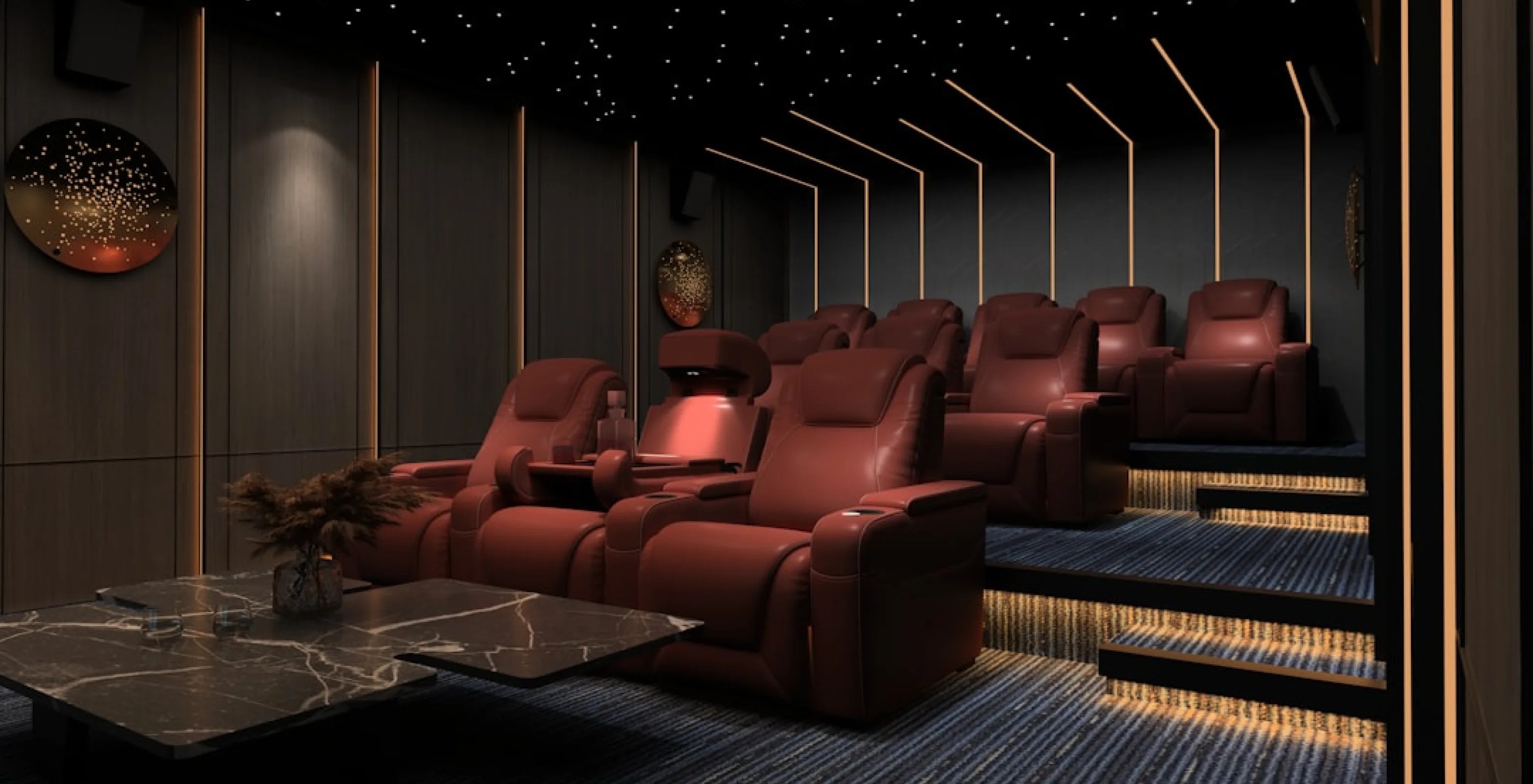
What Is a Wall Hugger Recliner? How Much Space You Need Behind Theater Seats
Share
You've measured the room, and the back row has to sit close to the wall. Will a recliner even fully recline there?
That's exactly the problem a wall hugger recliner solves. A wall hugger recliner, also called a wall saver or wall-away recliner, uses a forward-glide mechanism: instead of the backrest tilting backward into the room, the whole seat moves forward as you recline. That lets it sit much closer to a wall than a traditional recliner.
Coming up: how the mechanism works, how much clearance to actually plan for, and how it's different from a spacesaver arm.
It's the design behind much of the space-saving theater seating, including 4Seating's Spacesaver line, and it's worth understanding before you measure a narrow room for a row.
How Does a Wall Hugger Recliner Mechanism Work?
A wall hugger recliner reclines by moving the entire seat forward as the backrest tilts, rather than swinging the backrest into open floor space behind it.
A standard recliner pushed against a wall either won't fully recline or bumps the wall every time someone leans back, because the backrest pivots backward on a fixed base. A wall hugger avoids that problem by putting the motion in front of the seat instead of behind it. The footrest still extends out in front the way any recliner's does, the difference is only in which direction the chair itself travels.
If you're shopping in a showroom, sit in the chair and recline. If the whole seat eases forward as the back goes down, rather than the backrest alone tipping into the room behind you, that's a wall hugger.
This matters most in home theaters and media rooms, because rows are usually placed with their backs close to a rear wall or a riser edge, not floating in the middle of a room the way a living-room recliner might sit. A wall-hugger row lets you push seating back toward that wall and reclaim floor space in front for a coffee table, a walkway, or simply a less cramped room. A wall hugger changes which direction the chair moves, not how far back it reclines.
How Much Clearance Does a Wall Hugger Recliner Actually Need?
Wall clearance is the space a seat needs between its back and the wall when fully reclined. Check the Specifications tab for the model you're considering before you measure your wall.
Across Seatcraft models, wall clearance runs from about 3" to 6.5". A few examples from the product pages:
- The Sienna needs 3" from the wall to fully recline, and the Grenada and Rialto each need 3".
- The Venetian needs 3.5".
- The Napa Spacesaver and the Julius Big & Tall each need 5".
- The Pantheon Big & Tall needs 6.5".
That's the catch with the name: a chair that needs 3" and one that needs 6.5" are both called wall huggers, and the difference matters if you're working with an exact wall measurement rather than a rough estimate. If a flat number is quoted to you as a rule for all wall huggers, confirm it against the model you're actually ordering.
Wall Hugger vs. Standard Recliner vs. Spacesaver: What's the Difference?
These three terms describe two separate things: how the chair reclines, and how wide its arms are. A recliner can be a standard design or a wall hugger, and separately, its arms can be full-width or a narrower spacesaver cut.
Side by side, here's how they compare:
| Feature | Standard recliner | Wall hugger recliner | Spacesaver |
|---|---|---|---|
| How it reclines | Backrest tilts backward into open floor space | Seat glides forward on a track as it reclines | Varies, often paired with a wall-hugger mechanism |
| Rear clearance needed | Varies by model, check the Dimensions tab (Full Recline) | About 3" to 6.5" from the wall, check the model's Specifications tab | Same as whatever recline mechanism it uses |
| Arm width | Standard-width arms | Same as a standard or spacesaver arm, this is a separate feature | Narrower armrests to shave width off a row |
| Best for | Rooms with open space behind the seating | Rooms with a wall, riser edge, or short depth close behind the row | Narrow rooms where every inch of row width, not just depth, is tight |
A wall hugger buys you depth (front-to-back); a spacesaver arm buys you width (side-to-side) with a narrower armrest. 4Seating's Napa Spacesaver uses a narrower arm specifically to reduce total row width, useful if the wall's total width is your bottleneck rather than depth.
Some spacesaver models, including 4Seating's Sienna with its 3" wall clearance, are also wall huggers, so you get both savings, width and depth, in one seat. Always check a specific product's listed dimensions rather than assuming every model in a feature collection automatically combines every space-saving trait.
- Browse our Spacesaver Home Theater Seats
Fitting a Theater Row in a Narrow Room
Once you know a wall hugger buys you depth and a spacesaver arm buys you width, fitting a row into a tight room becomes a measuring exercise rather than a guessing game.
Start with the wall itself. On 4Seating's product pages, a row of 2 runs about 62 to 86 inches wide, a row of 3 about 90 to 126 inches and a row of 4 about 117 to 164 inches, depending on the model and whether it uses spacesaver arms. Measure your wall width first, subtract a few inches for outlets or trim, and compare that against the row size you want before you fall in love with a specific configuration. Each product page lists the exact width of every configuration.
Depth is the second measurement, and it's where the wall-hugger clearance question comes back in. Check the specific product's rear-clearance spec against your actual wall-to-nearest-obstruction distance, since a riser edge or doorway swing can eat into it too. If your room is tight on both width and depth, look for a model that combines spacesaver arms with a wall-hugger mechanism rather than treating them as two separate purchases.
If the room only has space for one seat right now, a single spacesaver recliner from 4Seating's single recliners can work as a starting point.
- Browse our Home Theater Single Recliners
For a broader look at laying out a tight room, screen distance, and choosing between a row, a loveseat, or a sofa, our small room home theater ideas guide covers the room-level decisions this post doesn't. For a straight row versus a curved layout, see our guide to home theater seating layouts. Measure the wall width first, then the depth behind it.
Where to Start: 4Seating's Top Space-Saving Picks
Whichever configuration you land on, 4Seating's home theater seating collection filters by seat count and feature.
- Sienna Italian Leather Spacesaver Home Theater Seating - one of our top sellers, combining spacesaver arms with 3" of wall clearance, so you save both depth and width in the same row.
- Napa Italian Leather Spacesaver Home Theater Seating - narrower arms built to shave width off a row, with a 5" wall clearance, a good fit when the wall's total width is your tightest constraint.
- Grenada Italian Leather Home Theater Seating - needs 3" from the wall, in rows of two to five.
- Rialto Italian Leather Home Theater Seating - Italian leather with a 3" wall clearance, a good everyday row.
-
Diamante FX Flip-Up Headrest Home Theater Seats - a flip-up headrest style that needs 3" from the wall.
-
Browse our Home Theater Seating
A couple of inches can matter, so compare a specific model's clearance and width against your room measurements before you order. Check the wall clearance listed on the product page's Specifications tab; a wall hugger recliner ships free anywhere in the continental US. For anything the product page doesn't cover, our customer help line is open during business hours at 1-800-407-8665.
About this guide: 4Seating has been selling home theater seating since 1997, including the wall hugger recliners covered here.