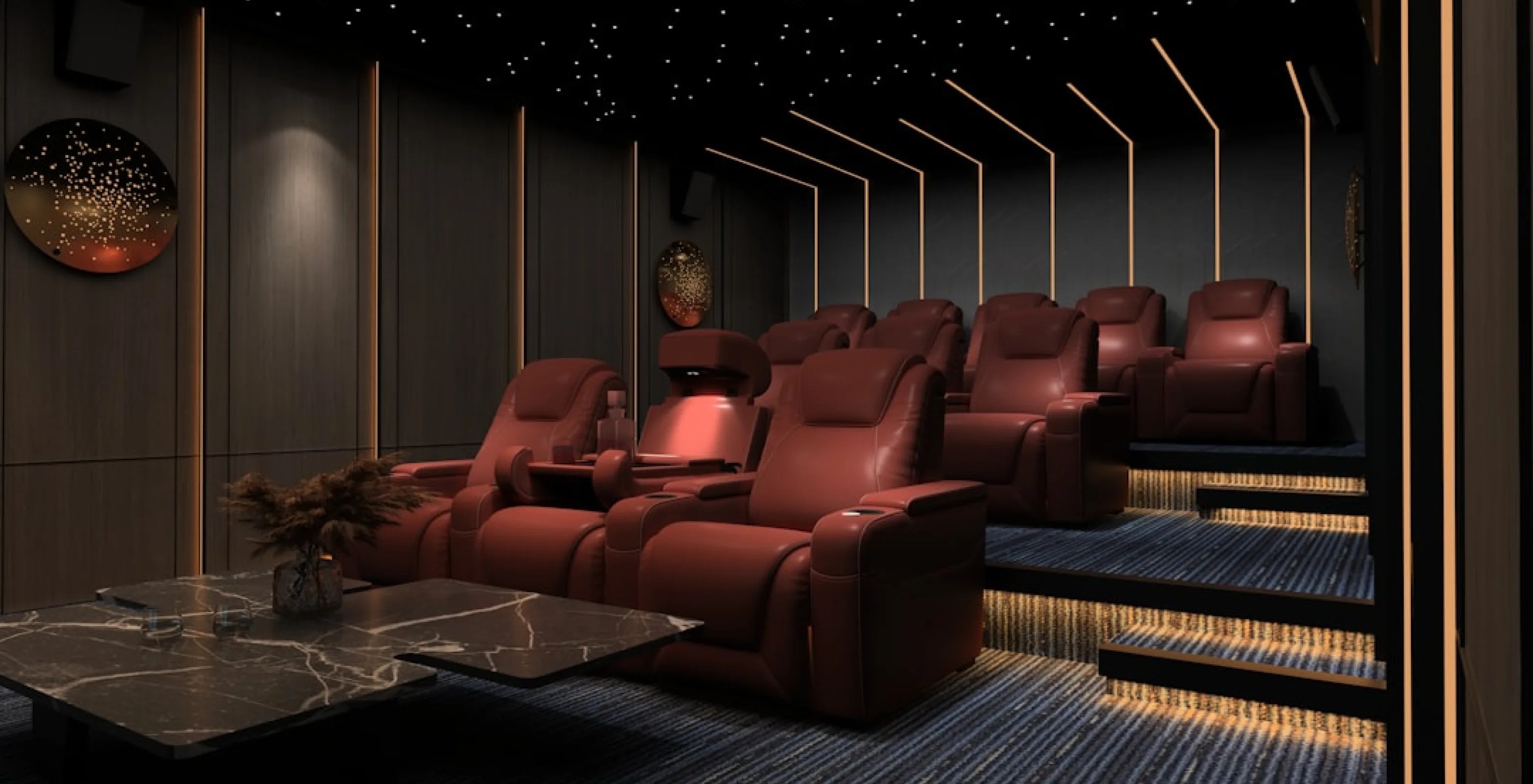
Loveseat vs Sofa for a Media Room: Sizes, Seat Count & Layout
Share
Four people, one couch, and whoever sat down last is hanging half off the arm. That's the loveseat-vs-sofa question in one scene: how many people need a real seat, and how much wall you have to give them.
A sofa seats three or more people in one connected piece, and as a three-seat home theater row it runs about 90-126 inches wide. A loveseat seats two, and as a two-seat home theater row it runs about 62-86 inches wide, depending on the model.
Measure your wall for either shape first, since that often settles when a loveseat actually beats a sofa. After that, we'll show how to pair the two in an L without the room reading like two separate purchases.
4Seating's sofas and sectionals collection carries both shapes, so pick a sofa for a room's main seating and a loveseat for a second row, a couple's den, or a tight footprint.
Loveseat Dimensions vs. Sofa Size: How Much Wall Each One Needs
The clearest, most consistent difference between a loveseat and a sofa is how many people each one seats, and how much wall it needs to do it.
Measure your available wall, then match it to the widths below rather than guessing from the word "loveseat" or "sofa" alone.
- Loveseat: seats 2. As a two-seat home theater row, widths run about 62-86 inches across 4Seating's models.
- Sofa: seats 3 (sometimes 2-3, since a middle cushion seats tighter than two dedicated seats). As a three-seat home theater row, widths run about 90-126 inches.
- Row of 4: not a traditional "sofa" term, but the natural next step up in a theater room, about 117-164 inches wide.
| Seats | Typical width (home theater row) | Best fit | |
|---|---|---|---|
| Loveseat | 2 | about 62 to 86" | Dens, bonus rooms, couples, second rows |
| Sofa | 3 (2 to 3) | about 90 to 126" | Main seating in most media rooms |
| Sofa + loveseat set | 5 | Two separate pieces, add the two widths | L-shaped layouts, front-and-back placement |
| Row of 4 | 4 | about 117 to 164" | Wide media walls |
For example, the Seatcraft Anthem Loveseat is 75 inches wide, and the Seatcraft Diamante CoolZeroᵀᴹ Table Console row of 2 is 75 inches. The exact width of each configuration is listed on the product page.
Width is only half the story once power recline enters the picture. A reclining theater piece needs clearance behind it, not just space in front of it, so a loveseat or sofa that fits the wall perfectly at rest can still crowd a walkway once the seats are reclined.
Measure the wall first, then check each product's own spec sheet for width, upright depth and reclined depth. Those numbers vary model to model even within the same seat count. The Seatcraft Anthem Loveseat Italian Leather, Powered Headrest, Power Recline, for example, is 41" deep upright and 72" deep fully reclined, and it needs 6.5" between the back of the seat and the wall to fully recline. That gap is what wallhugger models are built to shrink (about 3" to 6.5" across Seatcraft models), and the Specifications tab shows it for each one.
If you're weighing a loveseat or a sofa against a specific screen size, work out your row width first, then check it against how far your seating should sit from the screen. A loveseat pulled too close to a large screen undercuts the comfort a smaller footprint was supposed to buy you. Match seat count to your wall first, then check reclined depth before you order.
The Home Theater "Loveseat": Two Seats, One Connected Piece
A home theater loveseat is a two-seat version of a reclining theater row, built for a dedicated media room rather than scaled down from a living-room loveseat. Loveseat configurations (two seats, no center console) are available on many rows, not just as a standalone model.
The two seats often power-recline independently of each other, but how the middle of the piece is built varies by model. Some, like the Seatcraft Diamante CoolZeroᵀᴹ Table Console Home Theater Seating, build in a console with a small table between the seats, so each side reclines on its own.
Others are built as one connected two-seat piece, closer to a small sofa that happens to seat two. The Seatcraft Anthem Loveseat is one example, listing a powered headrest and power recline.
That split matters when you're deciding what to buy. A console version gives each seat its own space for drinks but reads more like two chairs pushed together. A continuous version looks and sits closer to a real sofa, at the cost of a shared armrest instead of a private one.
Neither style is standardized, so "loveseat" tells you the seat count, not whether there's a console between the seats. Check the product photos and spec sheet before you order.
A lounge loveseat, by contrast, is closer to a traditional living-room loveseat: a fixed or manually adjustable two-cushion piece built for everyday sitting rather than a dedicated power recline, cupholders or a lighted base. It's the better fit for a family room or den that only occasionally doubles as a media space, where you want a couch that looks at home outside movie night too.
Combining a Sofa and a Loveseat in an L
A sofa and a loveseat placed at a right angle, sofa along the long wall, loveseat along the short one, is a space-efficient way to seat five people in a media room without going to a full sectional.
Think of it like a dining table and a bench seat along one side: both face the same point, but they're two separate pieces you can rearrange later. Both pieces face roughly toward the screen, unlike a sectional's corner seats, which face partly across the room instead of straight ahead. Because both pieces ship and move independently rather than locking together, it's also easier to rearrange later if you change the room's layout.
Some models, like the Seatcraft Anthem Sofa & Loveseat Italian Leather, Powered Headrest, Power Recline, come as a matched sofa and loveseat set with the same upholstery and finish across both pieces, which keeps an L-shaped pairing from reading like two unrelated purchases.
- Browse our Cuddle Furniture
If you'd rather have one wide seat for two instead of a sofa-and-loveseat pair, cuddle seats and cuddle couches are a single-frame alternative worth a look for a similar footprint.
If your room is wide enough for one connected piece instead of two, it's also worth checking whether a sectional sofa fits your wall better than a separate sofa-and-loveseat pairing. Most sectionals come in a fixed arrangement, and you can usually rearrange only the middle seats and the corner, which some rooms want and others don't.
Which One Should You Actually Buy?
For most dedicated media rooms, a sofa, or a full row, is the better main seat. It seats more people per foot of wall and reads as the room's anchor.
A loveseat earns its place as a second row behind the sofa, as the sole seat in a small den or bonus room, or as one half of an L-shaped pairing. Neither is a compromise pick, it's a question of how many people need a regular seat and how much wall you have to give them one.
A few scenarios make the choice easier:
- A family of four or more, one room: start with a sofa or a 3-seat row as the front seat, and add a loveseat or a second row from 4Seating's full home theater seating lineup behind it, rather than trying to fit everyone on one piece.
- A couple, a bonus room, or a small den: a loveseat alone is often the whole answer, it seats two comfortably without eating a wall a sofa would need.
- A room that's also a guest space or home office: a lounge-style loveseat (no console, no dedicated recline mechanism) often fits that dual purpose better than a full theater loveseat built around movie nights.
-
A wide media wall with a mixed-use household: a sofa-and-loveseat L, or a sofa with a full row behind it, seats the most people without forcing everyone into identical recliners.
-
Browse our home theater seating
Before you order either, measure the full wall width, subtract a few inches on each end for clearance, and confirm recline depth for whichever model you're considering. If the seats are power recline, they plug into a standard 110v wall outlet and each seat may need its own, while manual models don't plug in; a licensed electrician can advise on new outlets. Getting a sofa or loveseat through a doorway or stairwell is usually not the limiting factor (measure your narrowest turn to be sure), so the wall and the walkway behind it settle most of the decision.
The takeaway: pick seat count for your household first, then let the wall and the walkway settle the rest.
Each product page shows its configuration options, and sample swatches are available for many upholstery options. A loveseat, a sofa or a sectional ships free anywhere in the continental US. If you're still unsure, our product specialists are on the customer help line during business hours at 1-800-407-8665.
About this guide: 4Seating has sold home theater seating since 1997, including the loveseats and sofas in this guide.