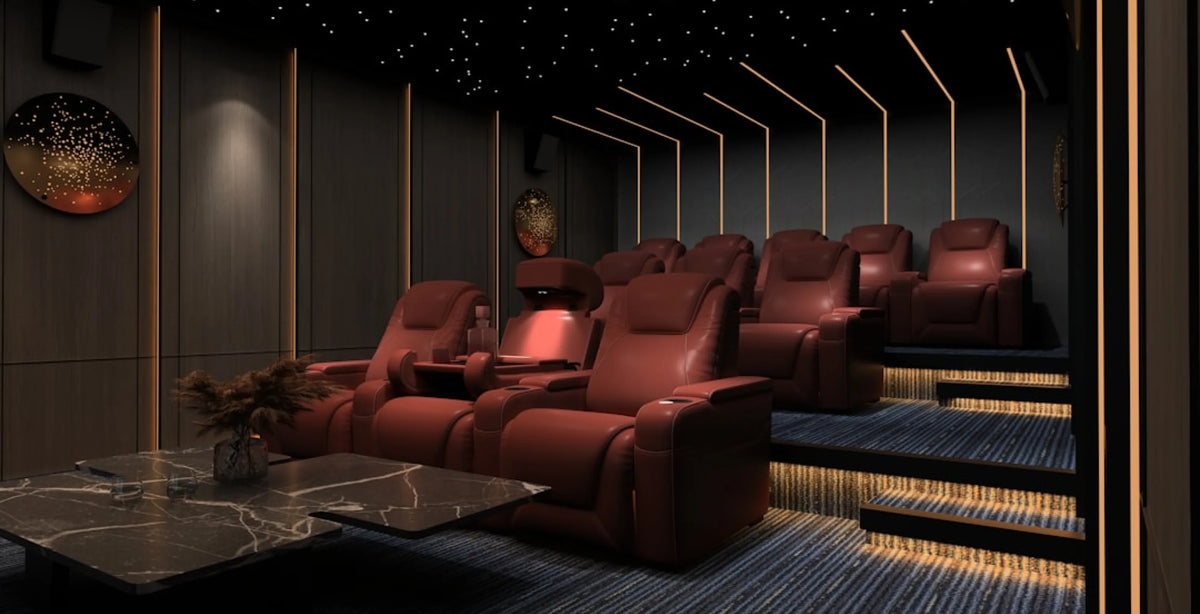
How to Choose Home Theater Seating in 7 Steps
The screen is mounted, the lights are dimmed, and now you have to decide what to actually sit on. It's tempting to click on whatever row looks good in a photo.
How do you choose home theater seating? It comes down to seven decisions: measure your room, pick a seat count, choose between rows, a sofa or a sectional, pick your upholstery, then your power features, comfort features and a delivery plan. Get your room's measurements right first; everything else, from seat count to row width, follows from that one number.
Start with your wall width, because it sets your seat count. From there, pick the seating type that fits how you actually use the room, then run through what to ask before you check out.
Home theater seating is a bigger investment than a regular sofa, so it's worth working through these seven steps in order instead of falling for the first row that looks good online. Below is the full process, five questions to ask before you buy, a rundown of the main seating types, and some setup tips for once your seats arrive. If you'd rather browse first, our full home theater seating lineup is organized by row size and feature.
The 7 Steps to Choosing Home Theater Seating
1. Measure your room first
Grab a tape measure before you look at a single product. You need three numbers: the usable wall width (subtract out baseboards, vents or columns), the depth from the screen wall to the back wall, and your ceiling height if a second row on a riser is on the table.
Leave room behind the last row for airflow and walking, and check the door swing into the room. It often eats into one end of a seating row without anyone noticing until the sofa won't fit through.
Viewing distance factors in too. A wider field of view sits closer to the screen, a narrower one sits farther back, and the exact math depends on your screen size. Our couch-to-TV distance guide has the full chart. Three numbers and a tape measure take a few minutes, and once the wall width is right, the rest of this guide gets much easier.
2. Decide your seat count
Once you know your usable wall width, seat count comes from comparing it with the row widths listed on the product pages, not from a per-seat formula. Each configuration lists its width, so the question is which row fits your wall with space left over at the ends.
Try this: take a 12-foot (144-inch) wall. A row of 3 runs about 90 to 126 inches depending on the model, so it fits with roughly 18 to 54 inches to spare. A row of 4 runs about 117 to 164 inches, so only the narrower models fit: the Sienna Spacesaver row of 4 is about 117.5 inches wide, which leaves about 26 inches. A row of 5 (about 145 to 178 inches) doesn't fit that wall at all.
How much open floor you leave beside the row depends on your room. If the space has to meet local building code, check with your building department; the International Code Council publishes the model code many jurisdictions adopt. Each product page lists the exact width for every configuration, and reclining seats, consoles and loveseat sections all change the number, so confirm the row you like before you order.
If your number lands between two row sizes, size down and keep the room comfortable to move through.
| Row size | Typical row width | Best for |
|---|---|---|
| 2 seats | About 62-86" | Couples, dens, smaller media rooms |
| 3 seats | About 90-126" | Most family theaters |
| 4 seats | About 117-164" | Dedicated theaters, basement builds |
If your wall comfortably fits more seats than one row should hold, look at a second row on a riser instead of stretching a single row too long. A long row pushes the end seats off-center from the screen.
3. Rows, a sofa, or a sectional?
A dedicated, single-purpose theater usually calls for connected rows. A room that doubles as a media room, game-day spot or everyday living space usually does better with a sofa or sectional.
Think about how the room gets used on a random Tuesday, not just movie night. A dedicated theater with no other job calls for connected rows: everyone gets their own recline and footrest, and a curved row (built with wedge consoles) angles the outer seats toward the screen. A room that also hosts football Sundays and everyday lounging stays comfortable for sitting upright and reading just as much as for reclining.
Sectionals deserve a closer look if the room isn't a single-purpose theater. They seat a group without a center aisle, the way a family gathers around one big piece rather than a row of chairs. The trade-off: a very wide sectional can push some seats off-center from a large screen.
Our companion guide, what is a sectional sofa, covers sizing and configuration if you're leaning that way. One purpose points to rows; several purposes point to a sofa or sectional.
4. Pick your upholstery
Think about what actually happens in this room: snacks, pets, kids piling onto the loveseat, maybe a spilled drink during the big game. Leather upholstery is generally easy to wipe clean, which makes it a popular choice for a dark, dedicated media room. Upholstery names vary by product (Italian leather, leather gel, fabric and more), so check the "Upholstery Material" line on each model's Specifications tab, and follow the manufacturer's care guidance on our materials page.
Fabric and microfiber suit a bright, multi-purpose room better. They don't show fingerprints or dust the way dark upholstery can, and they don't feel cold to sit on. The trade-off is more frequent spot-cleaning and a slightly more careful eye for stains. Sample swatches are available for many upholstery options if you want to see one in your own light.
Quick check: picture the room in daylight, not just movie-night lighting. Bright, shared space, lean fabric. Dark, dedicated theater that mostly gets used with the lights off, leather upholstery is a natural fit.
5. Choose your power features
Many home theater seats offer power recline, and many pair it with a power headrest so you can tilt your head forward and keep the screen centered even fully reclined. The power headrest theater seating collection groups models around that feature, then lets you layer on power lumbar, heat and massage, or a wedge console.
- Browse our Power Headrest Theater Seating collection
Power recline models plug into a standard 110v wall outlet (the Specifications tab lists "Standard 110v Plug"), and each seat may need its own outlet. Manual models don't plug in at all. If you need an outlet added near the row, a licensed electrician is the right person to ask. In a multi-row layout, decide where each row's power cord will run before you finalize furniture placement.
Power recline and a headrest are worth building your budget around first. Everything else here is a layer you add on top.
6. Choose your comfort features
Comfort features split into three tiers: recline and headrest adjustment (the baseline most buyers want), convenience add-ons like USB charging on some models, and extras like base lighting for a more immersive feel.
One feature worth understanding on its own is zero gravity recline. It tilts the whole seat back and raises your legs and knees, easing your back down into a deep lounge position. It suits long movies and extended gaming sessions because you can settle into one reclined position and stay there.
Pairing it with a power headrest keeps your eye line on the screen even at a deep recline.
Our guide to zero gravity home theater recliners compares it directly against standard recline.
The Luminis Zero Gravity Home Theater Seating with Heat & Massage, 4Seating's best-selling model, pairs zero gravity recline with heat and massage, a useful benchmark for a fully loaded comfort tier. Start with recline and a headrest, then add zero gravity, heat, massage or lighting only for what you'll actually use.
7. Plan delivery and setup
Many home theater seats ship in sections, which usually makes it easier to get them through a doorway than a single assembled piece.
Before you order: measure your entryways, hallways and any stairs the boxes travel through, then double-check the fully reclined depth of the model you want. A chair that clears a doorway upright can take up a lot more floor space once it's reclined, so plan with extra room to spare. Each product page lists "Full Recline" in the Dimensions tab.
4Seating seats ship free to every address in the continental US. Transit times are estimates, so build in some slack before the room is due to be finished. Qualifying in-stock seats ordered before 2pm PST can ship within 24 hours, with restrictions.
Measure the path in before you measure anything else. A seat that doesn't fit through the door won't matter how comfortable it is.
5 Questions to Ask Before You Buy
Before you check out, run through these five questions once more.
Will it actually fit? Confirm the row's full width against your wall, its reclined depth against anything behind it, and whether the boxes will clear your doorways and stairs.
How adjustable is the recline and headrest? Many models let you adjust the footrest, backrest and headrest separately, and a power headrest matters more the deeper the seat reclines.
What upholstery fits how you'll actually use the room? Leather upholstery is generally easy to wipe clean around kids and pets; fabric or microfiber has a warmer feel in a bright, multi-purpose space.
What's built in versus an add-on? Power recline and a headrest are common on mid-tier seats and up; lighting and massage are often feature-tier upgrades, so check the product page.
What happens after delivery? Ask what the warranty covers and whether white-glove delivery is available if you'd rather not move heavy sections yourself. Seatcraft seating carries a 1-year limited warranty, and the optional 5-Year Accident Protection Plan covers accidental stains and damage from delivery, and frames, springs, mechanisms and motors in years 2 to 5.
Types of Home Theater Seating
The right type depends on how the room gets used day to day, not just how it looks in a photo.

| Type | Best for | Trade-off |
|---|---|---|
| Single recliners / rows | Dedicated theaters, independent recline per person | Takes the most floor width per seat |
| Sofas | Multipurpose rooms, casual seating between movies | Harder to give every seat a centered view of a large screen |
| Sectionals | Groups, family rooms, flexible configurations | A very wide sectional can push outer seats off-center |
| Chaise seating | An informal front "kids' row" or stretched-out lounging | Less structured than a recliner for long, upright viewing |
| Loveseats & consoles | Couples, smaller rooms, adding a shared console table | Fewer independent recline positions than single seats |
Rows of connected recliners come closest to a commercial cinema feel, especially with a center console between two seats. Sofas and sectionals feel more like living-room furniture with theater features layered on top, built for everyday sitting as much as movie night. Chaise-style seats tend to show up as an extra rather than a main row. Loveseats and console configurations split the difference: two people, one shared armrest table, no full row needed.
Match the type to how the room gets used most days, and let movie night be the bonus, not the only use case you plan around.
Comfort and Setup Tips
A few small choices matter once the seats are actually in the room.

Leave walking room between rows. If you're running two rows, plan enough space for someone to pass without disturbing the front row, and confirm your riser height works with your ceiling before you order one. SoundRight risers come in 7" and 14" heights, which changes how much clearance the back row needs overhead.
- Browse our Home Theater Risers collection
Check wall clearance on wall-hugger models. A wall-hugger is a recliner that needs less space between the back of the seat and the wall when fully reclined. The clearance runs from about 3 inches to 6.5 inches across Seatcraft models (the Sienna needs about 3 inches, the Napa 5 and the Pantheon 6.5), so check each model's Specifications tab before pushing a row up against a wall.
Match materials to the room, not just the screen. A bright, multi-purpose room usually looks better in fabric or a lighter tone; a dark, dedicated theater can carry a deeper color without feeling heavy.
Keep a soft cloth nearby. Spills are easiest to handle in the first few minutes, and general mild-soap guidance applies to most upholstery. For anything stronger, follow the manufacturer's care guidance on our materials page.
Dim or disable base lighting if it's too bright. LED base lighting looks great in photos, but in a pitch-black room it can be more distracting than atmospheric. Look for models where it's dimmable or can switch off entirely.
Once your layout is set, you won't pay shipping on any 4Seating seat in the continental US. To order by phone or ask a remaining question, call our customer help line during business hours at 1-800-407-8665.
About this guide: 4Seating has been selling home theater seating since 1997, including the seats and sofas covered here.