How to Choose a Couch for a Home Theater
Friday night, the lights go down, and everyone wants their own spot to stretch out while the screen is still glowing. That's the night a theater sofa earns its keep.
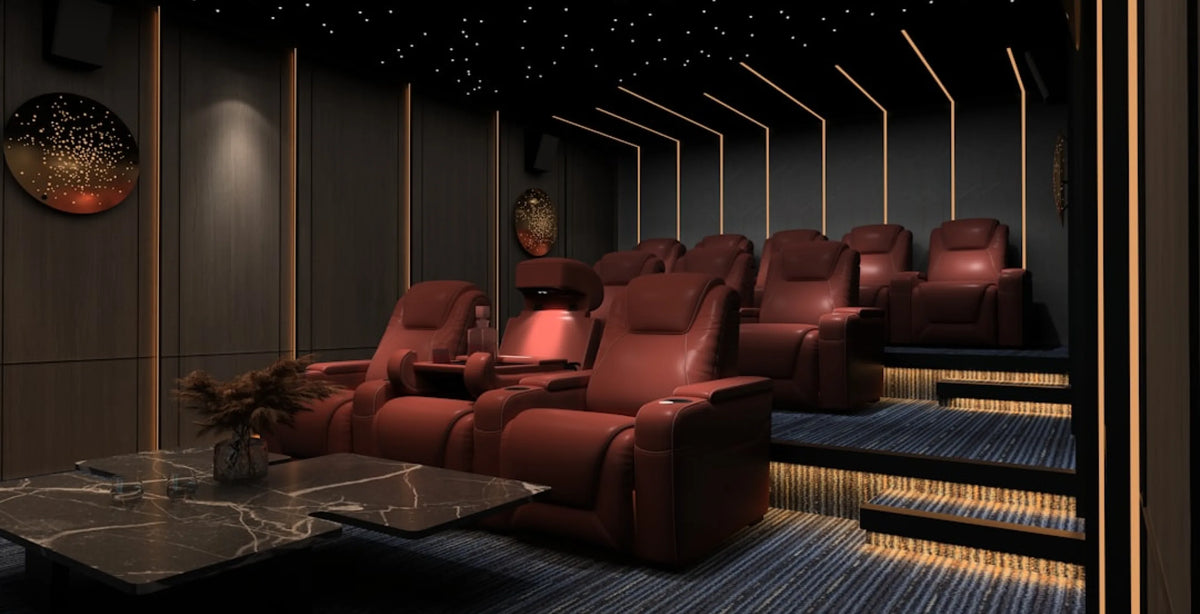
The best couch for a home theater is a theater sofa, sometimes called a cinema sofa: seating that can recline seat by seat, with cup holders, in-arm storage or power controls on many models. Pick one by matching seat count and width to your wall, then choosing the features your household will actually use.
How does a theater sofa differ from the couch in your living room? The sections ahead answer that, then cover how to size one to your wall and which features are worth looking for. Browse 4Seating's media room couches to compare styles as you go.
What Makes a Sofa a "Theater Sofa" (or Cinema Sofa)?
A theater sofa, also called a cinema sofa, is a couch built for watching movies or TV for long stretches, not quick everyday sitting.

Think of the difference between a park bench and a hammock. Both hold you up, but only one is built to keep you comfortable for three hours straight. A theater sofa is the hammock.
Here's a fast way to spot one in a showroom: sit down, recline, and watch whether the seat next to you moves too. If it doesn't, you're in a regular sofa. If it reclines on its own, independent of the rest of the piece, that's a theater sofa.
That independent recline, a firmer and deeper build that stays comfortable fully reclined, and small conveniences placed where you can reach them in the dark, such as cup holders, in-arm storage and USB charging on some models, are what set a theater sofa apart.
Foam density is listed model by model on each product's Specifications tab. The Wilshire Home Theater Modular Chaise Sofa lists 2.2 high density foam, for example, while the Seatcraft Anthem Sofa lists 1.8 density foam. Upholstery varies by model too, so read the Upholstery Material line on the Specifications tab (both of those list Italian Leather).
Features like power recline, powered headrests, in-arm storage and LED accent lighting show up on individual models rather than the whole lineup, so check each product page before you assume one is included.
Where a theater sofa really earns its name is in how it reclines: each seat moves on its own footprint, so one person can sit upright while the next stretches out flat. It's the same idea as a row of theater recliners, just built into one connected piece: a theater sofa looks like a couch but behaves like a row of recliners.
Theater Sofa vs. Regular Sofa
Side by side, the two aren't built for the same job.

| Feature | Theater sofa | Regular sofa |
|---|---|---|
| Recline | Individual recline per seat (manual or power, model-dependent) | Usually fixed, no recline |
| Storage & power | In-arm storage, cup holders and USB charging on some models, so check the product page | Rarely built in |
| Foam | Density listed per model on the Specifications tab | Varies widely by maker |
| Space behind it | Needs rear clearance to recline; wallhugger designs need less than non-wallhugger models | Sits flush against the wall |
| Best fit | A dedicated media room or theater used for long viewing sessions | Everyday living-room lounging, shorter sit times |
Neither is "better" outright, they're built for different rooms. A family room that also handles homework and guests usually does fine with a well-made regular sofa.
A room built around the screen, where people sit for two hours or more at a stretch, is where a theater sofa's recline starts to matter. Pick based on how the room gets used, not which one looks nicer in a photo.
How to Choose a Couch for a Home Theater: Sizing It to Your Wall
Before you look at upholstery or features, measure the wall. That one number rules out most of the wrong choices before you start comparing models.
Theater sofas and sectionals come in a handful of common seat counts, and these row widths for home theater seating give you a starting point:
| Configuration | Seats | Approx. width | Good fit |
|---|---|---|---|
| Row of 2 (loveseat) | 2 | about 62-86" | Small rooms, a second row, couples |
| Row of 3 (sofa) | 3 | about 90-126" | Many media rooms |
| Row of 4 | 4 | about 117-164" | Wide media walls |
| Sectional or pit | 5+ | Multiple connected pieces; total footprint is listed in each product's configuration options | Large rooms, corner or U-shaped layouts |
For example, the Wilshire Home Theater Modular Chaise Sofa row of 3 is 124", while the Seatcraft Anthem Sofa is 85".
Tape-measure the full wall width first, then subtract space for walkways. A common guideline is 30-36" for main paths and at least 24" between furniture pieces. What's left is your real budget for seat width, and the exact width of each configuration is listed on the product page.
Then leave room behind the sofa for recline. A wallhugger is a recliner that needs less gap between the back of the seat and the wall when fully reclined. Wallhugger clearance runs about 3" to 6.5" across Seatcraft models, so check the Specifications tab for the one you like: the Seatcraft Anthem Sofa, for instance, needs 6.5" from the wall to fully recline. For models that aren't wallhugger designs, the Dimensions tab lists Full Recline, the distance from the wall when the seat is fully reclined (the Anthem lists 72"), so keep tables and walkways beyond it.
That reclined footprint is the easy thing to miss, since most people only measure the sofa standing upright.
Power is the other thing to plan for. Power recline models plug into a standard 110v wall outlet ("Standard 110v Plug" on the Specifications tab), and each seat may need its own outlet, while manual models don't plug in. For anything beyond using an existing outlet, ask a licensed electrician.
Delivery is rarely the sizing problem people expect. Sectionals ship in sections, so a large sectional can usually move through a doorway or hallway piece by piece instead of as one oversized unit, though you should still measure your narrowest turn. Measure width first, then clearance on both sides and behind the seat.
Features That Actually Matter
Once you know your seat count and width, the feature list decides which model suits your room.
- Individual power recline. Look for seats that recline independently rather than as one shared unit. The Seatcraft Anthem Sofa lists power recline and an adjustable power headrest, which is what to look for on a spec sheet.
- Foam and warranty. Compare the foam density on each Specifications tab. Seatcraft seating carries a 1-year limited warranty, and the optional 5-Year Accident Protection Plan covers accidental stains and damage from delivery, and frames, springs, mechanisms and motors in years 2 to 5.
- Upholstery. Read the Upholstery Material line on the Specifications tab, since it varies by model. Sample swatches are available for many upholstery options, so request some before you commit to a color or finish.
- Storage, lighting and charging. Some models add in-arm storage, cup holders or USB charging to keep drinks and phones within reach in a dark room; check each product page for what's included.
- Configuration. Chaise, L-shape, U-shape and pit layouts let a sofa scale from a two-seat loveseat to a full sectional. The Wilshire Home Theater Modular Chaise Sofa shows how one modular platform can grow with the room.
If a sectional or pit layout is on your shortlist:
- Browse our Multimedia Sectionals & Pits
Thinking bigger than a single sofa? Our sectional sofa buying guide covers types, sizes and how to choose between L-shape, U-shape and modular layouts in more depth.
Where to Start: 4Seating's Top Theater Sofa Picks
The picks below are a starting point, and the Sofas & Sectionals Index covers chaise, modular and sectional layouts.
- Wilshire Home Theater Modular Chaise Sofa - a modular chaise platform that scales from a loveseat up to a full sectional.
-
Seatcraft Anthem Sofa Italian Leather, Powered Headrest, Power Recline - power recline and an adjustable power headrest.
-
Browse our Sofas & Sectionals Index
Sample swatches are available for many upholstery options, and each product page's Dimensions and Specifications tabs cover size and features. Seats ship at no charge anywhere in the continental US. If you're still unsure, our product specialists are on the customer help line during business hours at 1-800-407-8665.
About this guide: 4Seating has sold home theater seating since 1997, including the theater sofas in this guide.