




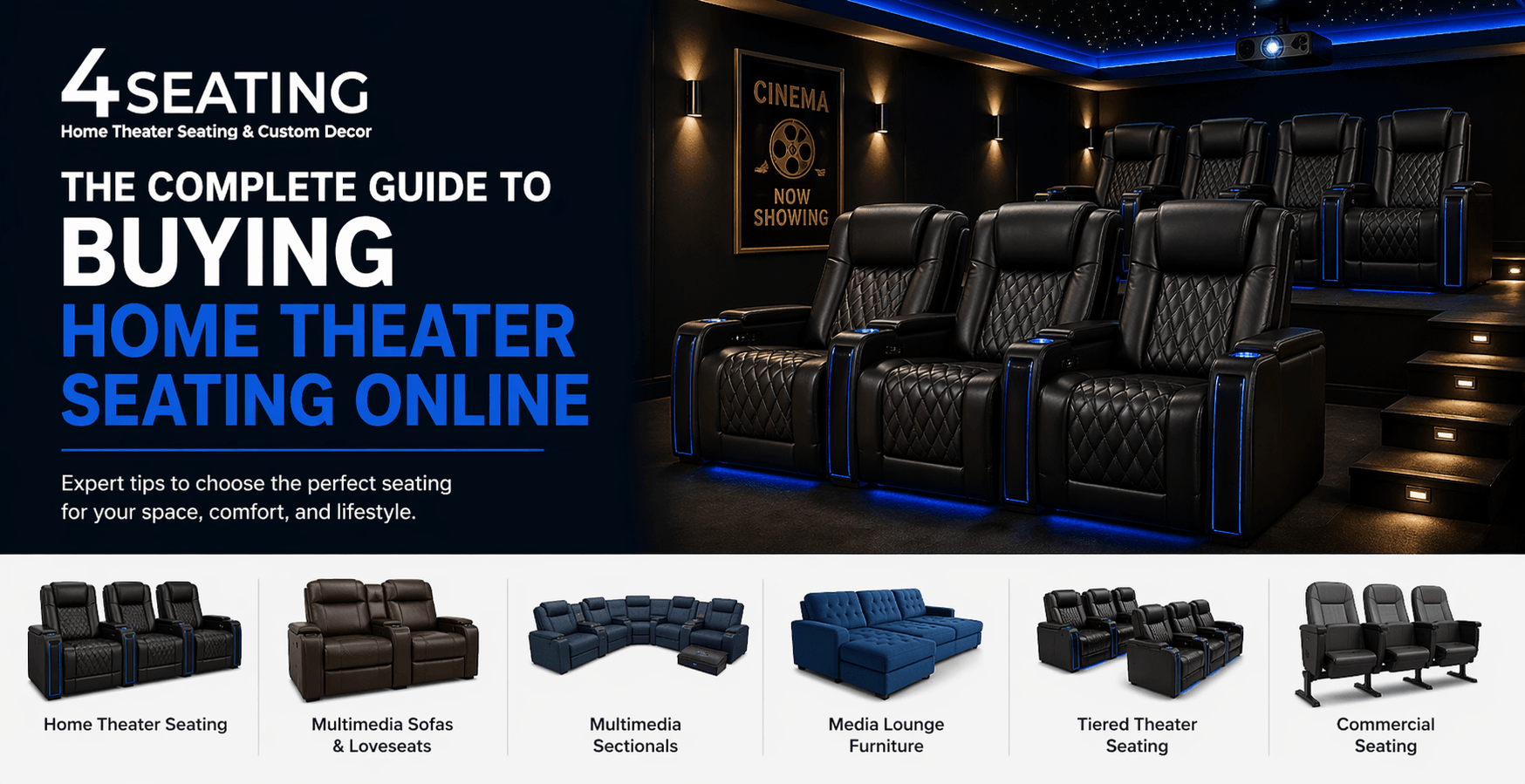
Most people start building their media room by obsessing over the projector and speakers, but the seat layout is what actually makes or breaks the room. Think about it: the exact same 100-inch screen feels cramped and overwhelming in a 10-foot room, yet completely distant in a 20-foot room. Your seating plan decides which experience you get.
When you buy home theater seating online, you bypass limited showroom floors and unlock custom setups that fit your specific space. But sorting through those options can be tough.
In this detailed home theater seating guide, we will share exactly how we help our customers design their rooms. We'll cover everything from choosing the right home theater seating layout and calculating viewing distances to prioritizing the features that survive spilled popcorn and kids' feet.
Measure Your Home Theater Space First
Before adding any home theater chairs to your cart, you have to know exactly what your room can handle. The biggest mistake we see isn't picking the wrong chair; it's buying furniture that swallows the room.
To measure your space, start with the "3-Step Room Snapshot." Grab a measuring tape and write down these three numbers before doing anything else:
- Usable Width: Measure wall-to-wall, but subtract any baseboards, columns, or HVAC bump-outs.
- Maximum Viewing Distance: Measure from your screen wall to the furthest point back you'd want to sit.
- Ceiling Height: Very important if you plan to build risers for a second row of seats.
Tip: Always check the door swing into the room (which often kills one side of a seating row) and leave at least 1-2 feet of space from the back of your last row to the back wall to prevent heavy bass build-up and leave room to walk.
How Many Seats Can Fit in Your Room?
Figuring out how many seats fit in a home theater doesn't require too much thinking.
The Rule of Thumb: For most standard recliners, multiply your desired seat count by 34 to 36 inches (the average width per seat when sharing armrests), then add at least one 20 to 24 inch aisle for walking space.
Home theater rooms fall into these layout patterns:
- The Narrow Cinema Row: Perfect for rooms under 13 feet wide. This features one central row of 3 to 4 seats shifted slightly to one side, leaving a single 24-inch aisle on the opposite wall.
- The Stadium Twin Rows: Best when a room is at least 16 to 17 feet long. This layout uses two rows of 3 to 4 seats with an 8-inch riser for the back row, giving everyone a clear view.
Understanding Viewing Distance & Angles
When planning your home theater seating arrangement, the distance to the screen controls your physical comfort. Sit too close, and you'll get neck fatigue; sit too far, and you lose the movie theater feel.
Cinema purists often use strict field-of-view THX formulas. However, in the real world, most of our customers are happiest when their main row is placed at a distance roughly 1.6 to 2.0 times the screen's diagonal measurement.
We also suggest tying your viewing distance back to what you watch most:
- If you watch a lot of fast-paced sports or game on your projector, sit slightly closer to feel right in the action.
- If most of your content is casual streaming, reality TV, or news, sit slightly farther back so your eyes don't have to dart across a massive screen.
Types of Home Theater Seating
There are many types of home theater seating, and the right choice depends entirely on how you use your room day-to-day. Here are our top home theater seating ideas and who they work best for.
Recliners
Home theater recliners are best for dedicated theater rooms where everyone wants to face the screen directly and control their own comfort.
For 13 to 15 foot rooms, we often recommend four single recliners arranged in a gentle curve. This creates two center "VIP seats" with slightly wider armrests, angling the outer seats perfectly toward the screen.
Explore our collection of Home Theater Recliners.
Sectionals
Sectionals are best for everyday family rooms where half the time you're watching a movie, and the other half you're napping, talking, or scrolling on your phone.
They feel great for everyday living, but they do make it harder to give everyone a perfectly centered view of a huge screen.
Browse our premium Multimedia Sectionals.
Chaise Lounge Seating
We often see chaises used as the informal front "kids' row." They are fantastic for family movie nights where someone always ends up sprawled on the floor with a blanket anyway.
Row Seating / Theater Rows
These are best when you want a true "movie theater" room and don't mind that the space is built entirely around seating and a screen.
A dual-arm recliner setup with a center drop-down console gives you a commercial cinema feel with the hidden convenience of a living room table.
Explore the Seatcraft Home Theater Seats Series.
Choosing the Right Material
Almost every home theater seating buying guide includes a basic leather vs. fabric home theater seats comparison. But at 4Seating, we look at your actual household habits to make a recommendation.
Leather (Top Grain & Vegan Options)
If you have pets that shed, kids with sticky hands, and a dark, dedicated media room, leather is much easier to keep clean. It survives spilled drinks and everyday wear and tear with no problem.
- Maintenance tip: We recommend a quick monthly wipe down with a damp cloth and conditioning it twice a year to keep the leather from drying out.
Fabric & Microfiber
If you have a bright, multi-purpose room with big windows, certain fabrics will hide dust and fingerprints much better than black leather. Fabric also doesn't trap heat, meaning it won't feel cold in the winter or sticky in the summer.
- Maintenance tip: Keep microfiber cloths and a small, upholstery-safe spot cleaner nearby in a storage armrest so you can tackle accidental spills right away.
Must-Have Features in Home Theater Seating
Finding the best home theater seats means looking beyond the cushions. Today's home theater seating features can be overwhelming, so we group them into three priority buckets:
- Comfort (Non-Negotiables): Power recline and power headrests.
- Convenience: Hidden armrest storage, USB/USB-C charging ports, and accessory docks for tray tables or wine glass holders.
- Wow-Factor: LED base lighting, lighted cup holders, and tactile bass shakers.
Tips for Buying Home Theater Seating Online
Learning how to choose home theater seating online is very handy, but only if you avoid common shipping headaches. Here are the three shipping mistakes we see most often when people buy from big-box retailers, and how to avoid them:
- The boxes don't fit through the doorway: Before buying, measure your home's entryways, staircases, and tight hallways.
- The fully reclined depth blocks a doorway: People often measure the upright chair, but forget that a fully reclined seat can lean back several inches and kick forward a foot or more. Look for "wall-hugger" designs to avoid this.
- Underestimating LED brightness: In a pitch-black room, generic LEDs can be annoyingly bright. Look for models where the LED lighting can be dimmed or turned off completely.
Always look for signs you can trust a company when shopping online: customer reviews, clear warranty terms, easy-to-find return policies, and white-glove delivery or installation options.
Why Buy Home Theater Seating from 4Seating?
If you want premium recliner seating for home theater spaces, 4Seating brings decades of focused experience directly to your living room.
- Versatile Inventory: We carry a wide selection of premium seating, catering to every style, room size, and budget.
- Custom Configurations: Whether you need a single recliner, a loveseat, or a curved row of six, we build your seating exactly how you want it.
- Competitive Pricing: Because we sell direct, you get showroom-quality luxury without the exorbitant retail markup.
- Trusted Brand: With years of experience, our dedicated home theater specialists are available to help you design your room and calculate your layouts.
- Fast & Reliable Shipping: We offer nationwide shipping with available White Glove delivery to make your installation completely stress-free.
Ready to start? Shop Home Theater Seating at 4Seating Now!
FAQs
How do I choose home theater seating?
Start with your room's dimensions and purpose. Choose structured recliners for dedicated theaters, or sectionals for multi-use family rooms. Then, select materials and features that fit your budget.
What is the best material for theater seats?
Leather or high-quality faux leather is best for easy cleaning, especially with kids or pets. For a softer, warmer feel and better room acoustics, choose a thick microfiber or performance fabric.
How far should seating be from the screen?
Aim for a distance roughly 1.6 to 2.0 times the diagonal size of your screen. For example, the "sweet spot" for a 100-inch screen is typically 13 to 16 feet away.
Are recliners good for a home theater?
Yes, they are usually the best option. Recliners give everyone independent control over their backrest, footrest, and headrest, eliminating the fight for the "best spot" on the couch.
How many seats fit in a home theater?
To find your max capacity per row: subtract 24 inches from your total room width for an aisle, then divide the remaining inches by 35 (the average width of a shared-armrest seat).
Is buying home theater seating online safe?
Yes, when buying from specialized retailers. At 4Seating, we make it worry-free with free material swatches, layout consultations, and white-glove delivery so you don't have to assemble heavy furniture.