What Is a Sectional Sofa? Types, Sizes & Buying Guide
Does one sofa leave a corner of your living room, or the whole back wall of your media room, looking half empty? That's the gap a sectional is built to close.
So what is a sectional sofa, exactly? It's built from multiple independent pieces, corner wedges, armless chairs and chaises (extended lounging seats), that lock together into one arrangement instead of sharing a single frame. Because the pieces separate, a sectional can usually travel through doorways and hallways a one-piece sofa can't.
Here's how to tell an L-shape, a U-shape and a modular apart, how to read left-facing versus right-facing before you order, and how to measure your own room so the piece you pick fits. Browse 4Seating's full sofas and sectionals collection to see the shapes below in person.
What Is a Sectional Sofa?
A sectional sofa is a large seating unit made of multiple independent pieces, armless chairs, corner wedges, chaises, and consoles (a table section between seats), that connect into one continuous arrangement rather than sharing a single frame.
That's also what separates it from an ordinary sofa or loveseat. A traditional sofa is a single fixed-width piece. A sectional is a set of pieces chosen to fit a specific room, corner, or media wall, and many also let you add a middle console, an ottoman, or a loveseat-style pairing at checkout.
If you've seen it called a "sectional couch" instead, it's the same thing. "Sofa" and "couch" are interchangeable; "sectional" just tells you it's built from sections.
Types of Sectional Sofas
There are five main types of sectionals, and each one solves a different room problem.

| Type | Layout | Best for | Real example |
|---|---|---|---|
| L-Shaped | A left-side seat, middle seats, a 90-degree corner seat and a right-side seat | Corners, den-style rooms | Wilshire L-Shaped Home Theater Modular Couch - 6-Piece or 7-Piece |
| U-Shaped | Three rows of seats around an open center | Large groups, media rooms | Seatcraft Heavenly Media Lounge U-Sectional - 6-Piece or 8-Piece |
| Chaise | Standard sofa plus one extended lounging arm | Small-to-medium rooms that want a stretch-out spot | Left- or right-facing chaise end |
| Modular | Independent pieces where the middle seats and the corner can be rearranged, while the left and right end seats stay at the ends | Households that like to try a new layout now and then | Look for "modular" in the product name, like the Wilshire and Diamante lines |
| Reclining / power | A sectional shape with power recline or consoles between seats | Home theaters and dedicated media rooms | See the multimedia sectionals collection, below |
A pit sectional is a U-shape arranged around a lounging area rather than upright seating. The Diamante Home Theater U Shaped Sectional Pit is one example, in 6-, 8- and 12-piece builds. For the U-shaped sectional layout specifically, 4Seating's U-shaped sectionals category narrows the catalog to that shape.
How to Tell Left-Facing From Right-Facing
In short: stand facing the sofa as you would from your TV. If the chaise is on your left, it's left-facing. On your right, it's right-facing.
Try it before you order: stand where your screen will sit and look back at the empty spot for the sectional. Decide whether the chaise goes under your right hand or your left: whichever side keeps the open, armless end facing into the room, not a doorway or a walking path, is the one to buy.
Left- and right-facing describe the chaise, not the sofa, so face your screen first and pick the side that keeps your traffic path clear.
Sectional vs Modular vs Sofa
These three terms get used loosely, but they're different.
| Feature | Sofa | Sectional | Modular sectional |
|---|---|---|---|
| Frame | One fixed frame | Several pieces joined into a set shape | Independent pieces, with middle seats and corner you can swap around |
| Reconfigurable | No | Mostly fixed, it comes in the arrangement you order | Partly, usually only the middle seats and the corner |
| Typical seats | 2-3 | 4-8+, depending on piece count | Set by the piece count you choose |
| Best for | Small rooms, formal layouts | A dedicated, large lounging zone | Rooms where you may want to change the middle of the layout |
A modular sectional is always a sectional, but a sectional isn't always modular. A fixed L-shaped or U-shaped sectional is sold as one set arrangement. A modular sectional gives you a little more room to play: the left and right end seats stay put, but you can usually rearrange the middle seats and the corner.
Most sectionals come fixed the way they ship. If you like the idea of reshuffling the middle later, look for a modular one. If you've found the shape you want for good, a fixed sectional is simpler.
Theater and Media-Room Sectionals
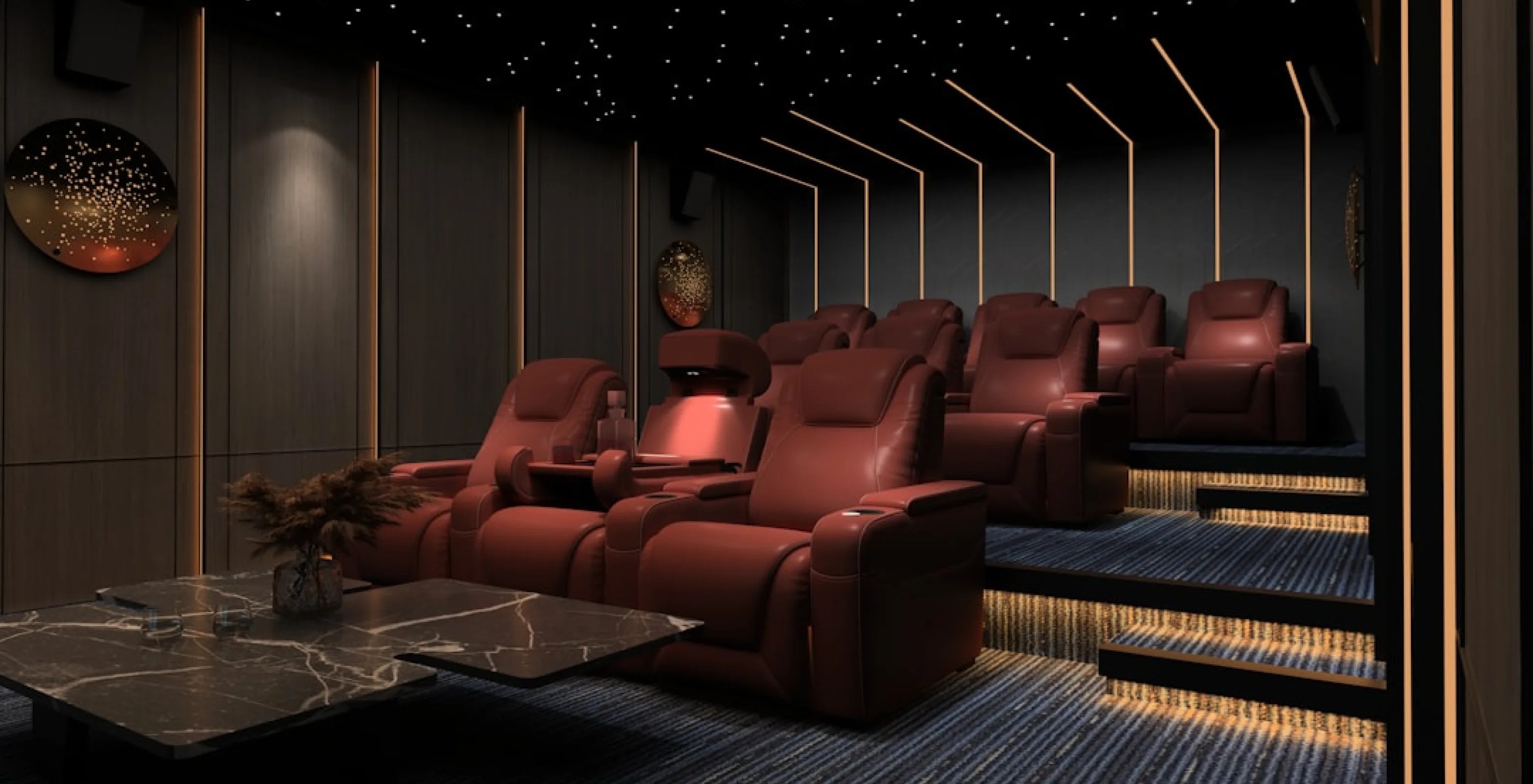
A sectional built for a media room often adds features a living-room sofa skips, such as power recline and consoles between seats for drinks and snacks.

The Diamante Modular Home Theater Sofa Console Table is one example: a fixed console between seats, built for this kind of setup.
Because these pieces ship in sections, they usually move through doorways and hallways more easily than a one-piece theater sofa, which helps in a basement build or an ordinary living room alike (measure your narrowest turn first). A media-room sectional also differs from a row of separate recliners: one continuous seating line instead of individual chairs side by side.
Browse our multimedia sectionals collection for the full range of power-recline and console builds.
Sectional Sofa Sizes and How to Measure
Sectional sofa dimensions start with row widths, since a sectional is two or more rows joined at an angle or corner. Home theater seating in a standard configuration runs about the following widths, and your exact model's page lists the width of each configuration.
| Row | Approx. overall width |
|---|---|
| 2-seat (loveseat) row | about 62-86" |
| 3-seat row | about 90-126" |
| 4-seat row | about 117-164" |
For example, the Sienna Italian Leather Spacesaver Home Theater Seating row of 3 is 90", while the Solis w/ Straight Console row of 3 is 126".
A sectional's full footprint, its widest point plus its depth, depends on the shape and piece count. You'll find it in each product's configuration options for the piece counts offered, so check it on the product page before you order.
To measure for a sectional before you buy, grab a roll of painter's tape and mark out the full footprint on your floor, both rows of an L-shape or all three rows of a U-shape, not just one row's width. Leave it down for a day and walk the room as usual, so you can see if it blocks a doorway or sits too close to the TV.
What to look for before you order: - The taped-out footprint fits with walking room to spare, not just the wall-to-wall width - Your narrowest doorway and hallway turn are wider than the largest single piece, since each piece is still one solid block - Whether you need left-facing or right-facing, decided before checkout - Wall clearance behind it, if it reclines. This is the gap you need between the back of the seat and the wall when fully reclined, and it varies by model: the Catalina FX Power Console Home Theater L Sectional needs 3" from the wall, while the Solis FX Flip-Up Headrest Home Theater L Sectional needs 5". Check the Specifications tab of the one you pick - The product page's own footprint, since it varies by model and piece count
A sectional's row width rarely tells the whole story once you add the corner and the second row, which is why the floor test is worth a day.
How to Choose the Right Sectional
Start with the room, not the sofa. Measure the space and hallway turns first, then pick a shape, L, U, chaise, or modular, that fits how you'll actually sit: facing a screen, facing each other, or both.
From there, three things narrow the choice fast:
- Material. Leather and fabric feel and clean differently. Each product's Specifications tab lists its Upholstery Material, and sample swatches are available for many upholstery options.
- Configuration. Most sectionals ship in a fixed arrangement. If you'd like a little flexibility, look for one where the middle seats and the corner can be rearranged later.
- Use case. A living-room sectional prioritizes face-each-other seating. A media-room sectional prioritizes facing the screen, with recline and consoles built in. See our guide to movie theater couches for more on that distinction. Settle fit first, then let material and use case decide which piece you order.
Where to Start: 4Seating's Sectional Picks
These three cover the range above.
- Wilshire L-Shaped Home Theater Modular Couch - the L-shape pick for a corner room, in 6-Piece or 7-Piece builds.
- Seatcraft Heavenly Media Lounge U-Sectional - the U-shape pick for a larger media room, in 6-Piece or 8-Piece builds.
-
Diamante Modular Home Theater Sofa Console Table - a modular pick with a fixed console between seats, in rows of 2, 3 or 4.
-
Browse our Sofas and Sectionals collection
- Browse our Multimedia Sectionals collection
- Browse our U-Shaped Sectionals collection
Each product page's Dimensions tab and dimension diagram make it easier to match a shape and row count to your room, and sample swatches are available for many upholstery options. Whichever configuration you choose, shipping is free anywhere in the continental US.
You can also browse the U-Shaped Sectionals collection and check each model's width on its Dimensions tab.
Still deciding on a shape? Our customer help line can support you during business hours at 1-800-407-8665.
About this guide: Since 1997, 4Seating has been selling home theater seating, including the sectionals covered here.