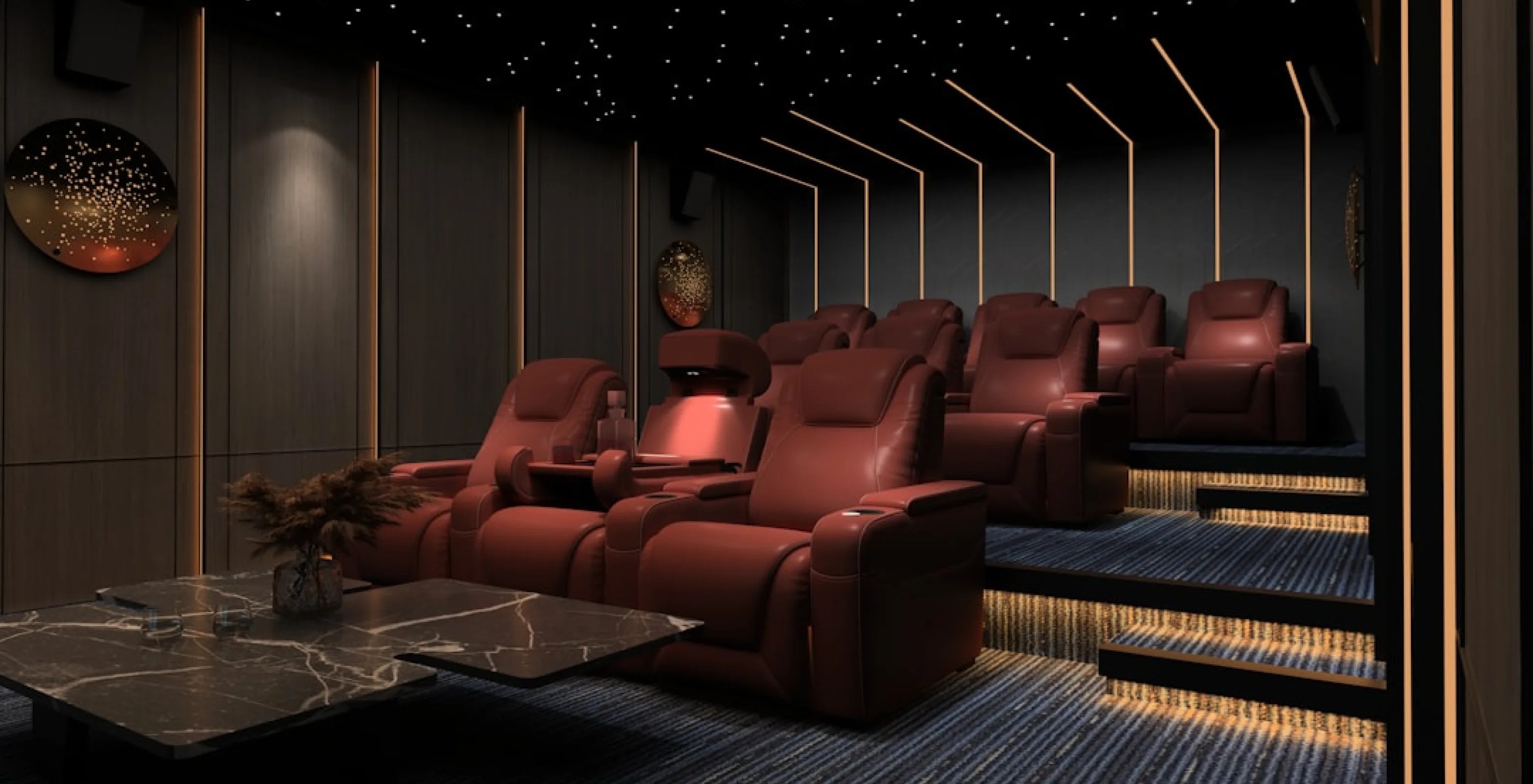
Living Room Home Theater: How to Build a Hidden "Sleeper" Setup
On a Tuesday morning your living room is just a living room: a sofa, a bookshelf, a throw blanket nobody folds. By Friday at 8 p.m. the screen glides down, the curtains close, and the headrests on the sofa flip up. That's a sleeper theater, and you can build one without giving up the room you actually live in.
A living room home theater works when four things line up: a projector bright enough for a room that never gets fully dark, an ambient light rejecting (ALR) screen matched to that projector, window coverings that tame the daylight, and seating that looks like furniture until you press a button.
Start with the checklist below, then jump to the part you're shopping for. If you'd rather begin with the seats, browse our Seatcraft home theater seats first.
What Makes a "Sleeper" Living Room Theater
A sleeper theater is a normal living room by day and a real home theater at movie time, with every piece of gear either hidden or dressed up as furniture. The goal is a room your family and guests can use all week, with a big picture on Friday night.
| Part | By day | At movie time |
|---|---|---|
| Screen | Rolled into the ceiling or a cabinet, or a fixed frame like a wall panel | Lowered, raised or already in place |
| Projector | On a low cabinet below the screen, or ceiling-mounted | On |
| Light | Curtains open, daylight in | Curtains closed, lamps off |
| Sound | Soundbar or in-wall speakers that look like part of the room | Full volume |
| Seating | A sofa or loveseat with a low-profile back | Power recline, headrests up |
How Bright a Projector a Living Room Needs
A living room needs a brighter projector than a basement theater, and projectors rated for brighter rooms tend to cost more than the entry-level models we cover in our home theater setup guide. The six below run about $2,500 to $5,300 at the time of writing (Oct 2026).
Brightness is measured in lumens (how much light the projector puts out). What matters for your eyes is how bright the image is on the screen, measured in foot-lamberts (fL). A common guideline is about 16 fL for a dark room, within a range of 12 to 22 fL. For a family room, a common guideline is about 50 fL, and bright rooms are often given 60 fL or more. That's why a projector that looks great in a dark basement can look washed out at 4 p.m. in a living room. Here's the formula for running your own numbers: lumens = fL × screen area (sq ft) ÷ screen gain. Gain is how much light the screen sends back toward you, with a plain matte white screen at about 1.0.
Here's a worked example for a 110" 16:9 screen, which is about 35.9 sq ft:
- At a 60 fL target and gain 1.0, you need about 2,154 lumens.
- With a screen at gain 1.3, the same target needs about 1,656 lumens.
Two cautions before you shop. First, check which standard the brightness number uses. "Lumens," "LED lumens" and "lamp brightness" have no industry standard, while ANSI lumens and ISO/IEC 21118 are defined test methods. ISO and ANSI figures are broadly comparable but don't convert exactly, so only compare numbers within one standard. Second, direct sun on the screen beats any projector, because average sunlight can exceed 50,000 lumens.
Ultra-short-throw or ceiling mount?
Throw ratio is the throw distance divided by the image width, so a 1.2:1 projector making a 10-foot-wide image sits 12 feet back.
An ultra-short-throw (UST) projector sits on a low cabinet just in front of the wall, and a 120" image needs only about 22" of throw distance. ProjectorCentral lists the pros as a large image from a short distance, easy placement and often built-in audio, with quality UST models running about $1,600 to $5,000. A standard-throw projector mounts on the ceiling or sits behind the seats, which suits a recessed ceiling screen.
Projectors rated for brighter rooms
Here are six projectors rated for brighter rooms. 4Seating doesn't sell them. They're listed by price, not by merit, and prices are about figures at the time of writing (Oct 2026), with MSRP where noted.
| Model | Type | Brightness (standard) | About |
|---|---|---|---|
| Hisense PT1 | RGB laser UST, 4K DLP | 2,500 ANSI lumens | $2,498 |
| Hisense C2 Ultra | Laser, standard throw, 0.90 to 1.50:1 zoom | 3,000 ANSI lumens | $2,999 MSRP |
| AWOL Vision Aetherion Max | Laser UST, 4K DLP | 3,300 ISO lumens | $3,799 |
| Hisense PX4 Pro | RGB laser UST, 4K, 0.19:1 throw | 3,500 ANSI lumens | $4,000 MSRP |
| Hisense L9Q | Laser UST, 4K DLP | 5,000 ANSI lumens | $4,832 |
| Epson QS100W | Laser UST, 4K pixel-shift 3LCD | 4,500 ISO lumens | $5,332 |
Within the ANSI group, the L9Q is brighter than the PX4 Pro per their spec sheets (5,000 vs 3,500 ANSI lumens), and the PX4 Pro is brighter than the C2 Ultra (3,500 vs 3,000). Within the ISO group, the QS100W is brighter than the Aetherion Max (4,500 vs 3,300 ISO lumens). The C2 Ultra's zoom range suits a ceiling mount, and the PX4 Pro's 0.19:1 throw ratio lets it sit very close to the wall.
For the room you have, work backwards: pick your screen size, run the formula for 50 to 60 fL, then look for a projector comfortably above that number.
ALR Screens: How Ambient Light Rejecting Screens Work
An ambient light rejecting screen reflects the projector's light toward the audience and redirects light that arrives from other directions. It only works when the room light and the projector light come from different directions, which is why the screen has to match the projector.
Match the screen to the projector
This is where most buying mistakes happen. ALR screens come in two main families:
- Ultra-short-throw screens (ceiling-light-rejecting, lenticular or Fresnel designs) are made for projectors that throw upward at a steep angle from a low cabinet.
- Long-throw screens (angular-reflective designs) are made for projectors mounted on the ceiling or placed back in the room.
Makers state that the two aren't interchangeable. One lists its angular-reflective screen as not compatible with UST projectors, and another says its Fresnel UST screen is incompatible with long-throw and ceiling-mounted projectors. Before you buy, check the projector's throw type against the type named on the screen's page.
What the tests show
ProjectorCentral measured contrast ratio, which is how much brighter the screen's white is than its black. In a 2016 test with window light on an 80" image, a plain white board measured 10:1, and the ALR screens measured about 27:1 to 36:1, so all 11 beat white. In a 2015 test, a white screen measured 86:1 in a dark room and 20:1 with a side window open.
Ceiling light is the easiest for these screens to reject. Light from the side, such as a window or a floor lamp, is the toughest case. In a fully dark room, the tested ALR screens showed no noticeable difference, so skip the feature if you'll only watch at night.
ALR has limits too. ProjectorCentral called a 2,400-lumen UST with an ALR screen bright enough for a living room, while noting that some light control is still wanted. UST plus ALR setups are often limited to about 100" to 120" images, and higher gain narrows the viewing cone, so check the listed viewing angle if people sit off to the side.
Screens That Disappear: Floor-Rising, In-Ceiling and Motorized
A screen can hide four ways: rising from a cabinet, dropping from a recessed slot in the ceiling, rolling down from a case, or sitting on the wall as a fixed frame that doubles as decor. Pick by where your projector sits, since that decides the screen type.
| Format | How it hides | Usual pairing | About (examples, Oct 2026) |
|---|---|---|---|
| Floor-rising | Rises from a low cabinet | The common UST pairing | About $1,900 to $2,900 |
| Recessed in-ceiling | Housing sits flush with the ceiling when closed | Standard-throw projectors; ALR versions for long throw | Starts around $1,000 for matte white, around $2,850 for long-throw ALR |
| Motorized drop-down | Rolls up out of sight | Either, if matched to the projector type | Varies; compare listings |
| Fixed frame | Doesn't hide, but flattest | UST CLR versions pair with UST projectors | UST CLR fixed frames start around $730 |
Manufacturers describe free-hanging motorized fabric as able to curl or wave, and tab-tensioned versions pull the sides taut to keep the picture flat.
On a tighter budget, projector screen paint is another route. Dedicated kits run about $100 to $160, and ordinary wall paint isn't the same thing, so source the right type.
Light Control in a Living Room
Plan on evening movies with the curtains closed and daytime viewing as a bonus. A projector can't project black, so any light that reaches the screen lifts black to gray and flattens contrast. An ALR screen helps, but it doesn't replace closing the curtains.

Start with the room itself. Light-colored walls and ceilings near the screen bounce the picture's own light back, and the ones closest to the screen matter most.
How to choose blackout curtains or shades
There's no formal standard for the labels. Retailers commonly call 99 to 100 percent light blocking "blackout" and about 95 to 99 percent "room darkening," with less than that called "light filtering." That rating describes the fabric, not the finished window, because light leaks around the edges.
To close the gaps:
- Extend the rod about 3" to 10" past each side of the window frame.
- Use a wraparound ("French return") rod so the curtain turns back to the wall.
- Mount the rod close to the ceiling, and overlap the center panels by 2" to 4".
- Remember that a blackout liner blocks light through the fabric, not around it.
Where to buy: home-goods and department stores, home-improvement stores, window-treatment specialists, and custom drapery workrooms that can make drapes to your measurements with a blackout lining. And check them in person if you can. A "blackout" label isn't a guarantee, so hold the fabric up to a bright light and see whether any comes through.
Motorizing the curtains
The SoundRight Electric Curtain Rod System from 4Seating is a motorized track, with the curtain fabric not included, so you bring your own blackout drapes. It runs from a remote or an optional control pad, with an optional timer. A dual-track option hangs a sheer curtain behind the main curtain, with each track running independently, and the product page lists compatibility with Crestron and other major home automation systems. 4Seating's SoundRight velvet curtains frame or cover the screen, but they aren't sold as blackout.
- Browse our Home Theater Curtains and Accessories
Sound You Don't See
The easiest sound to hide is a soundbar system, and the next easiest is in-wall or in-ceiling speakers, with a qualified installer doing the in-wall work. A soundbar system packs processing, amplification and speakers into one bar under the screen. Atmos bars aim upfiring speakers at the ceiling, so a flat ceiling suits them.
Wireless subwoofers and rear speakers come in the box with some systems and are optional on others. These four are examples of what's on the market, and 4Seating doesn't sell them. Prices are about figures at the time of writing (Oct 2026).
| System | Channels as stated | Dolby Atmos | Sub and rear speakers | About |
|---|---|---|---|---|
| Sonos Arc Ultra | 9.1.4 | Yes | Optional wireless sub and rears; bundle with the sub is $1,898 | $1,099 |
| Samsung HW-Q990H (2026) | 11.1.4, 23 speakers | Yes | Wireless sub and rears included | $1,999.99 |
| Nakamichi Shockwafe Wireless | 11.2.6, 31 drivers | Yes, plus DTS:X | 2 wireless subs and 2 wireless surrounds included | $2,499.99 list |
| Bose Smart Ultra Soundbar | 9 speakers incl. 2 upfiring | Yes | Optional Bass Module 700 ($699), up to 2 | $999 |
In those channel counts, the first number is ear-level speakers, the ".1" is subwoofers and the last is overhead speakers, so 5.1.4 is five ear-level speakers, one sub and four overhead.
In-ceiling speakers are the most invisible, with a catch. Dolby says an all-ceiling layout isn't recommended, because ear-level speakers belong at ear height, and it suggests Atmos-enabled upfiring speakers where ceiling speakers aren't possible. Passive in-wall and in-ceiling speakers also need an AV receiver, the hub that decodes the sound, switches HDMI sources and powers them.
Seating That Looks Like Living Room Furniture
Seats blend into a living room when the backs sit low by day and the extras hide in plain sight. Seatcraft's FX line is built around that idea: each seat has a power headrest that flips up when you activate it, so the back sits low and flat the rest of the time.

All four FX models share power recline, 7-color LED baselighting, a standard 110v plug, a chaise-style padded footrest, 350 lbs. per seat and an easy-off backrest. If you need an outlet added near the seating, a licensed electrician is the right person to ask. Here's how they differ:
- Diamante FX: Italian leather in 8 colors with a diamond-stitch pattern, consoles with storage and dual cupholders, and a 3" wall clearance for full recline.
- Catalina FX (power console): performance fabric seats with Italian leather arms in 8 color combinations. The storage consoles house a wireless charging surface with hidden cupholders and storage, and it needs 3" of wall clearance.
- Palisade FX: performance fabric, with a console table between each arm, curved outside armrests and a 3" wall clearance. It has no cupholders.
- Solis FX sofa: Italian leather in 17 colors, with padded arms that hold in-arm storage and USB-A and USB-C in each LED cupholder, one per seat. It needs 5" of clearance.
If you'd rather the seating read as a sofa, two of our best sellers come in that shape. The Anthem Sofa pairs Italian leather with power recline and a power headrest that tilts so the screen stays in view, and it needs 6.5" from the wall for full recline. The Armada LT HeatZero Sofa adds zero gravity recline, heat and power lumbar (an adjustable lower backrest cushion), with USB-A and USB-C in each LED cupholder.
Beyond those two, the media room sofa category and the wireless charging sofas and loveseats fit the same idea. And if you're still weighing a dedicated room against a living room setup, our guide on media room vs home theater lays out the trade-offs.
- Browse our Powered Headrest Theater Seating
- Browse our Media Lounge Sofas
Where to Start: 4Seating's Living Room Picks
- Diamante FX Flip-Up Headrest Home Theater Seats - flip-up power headrests and a low-profile back, in Italian leather.
- Catalina FX Power Console Home Theater Seats - consoles with a wireless charging surface and hidden cupholders.
- Palisade FX Home Theater Seating - a console table between each arm in performance fabric.
- Solis FX Home Theater Sofa - sofa form with in-arm storage and USB-A and USB-C charging.
- Seatcraft Anthem Sofa - a sofa shape in Italian leather, with power recline and a power headrest.
- Armada LT HeatZero Home Theater Sofa - zero gravity recline with heat, plus 7-color LED cupholders and baselights.
- SoundRight Electric Curtain Rod System - a motorized track for your own blackout drapes, with a dual-track sheer option.
Every seat ships free anywhere in the contiguous US. Sample swatches are available for many upholstery options. To order by phone or ask a remaining question, call our customer help line during business hours at 1-800-407-8665.
About this guide: 4Seating has been selling home theater seating since 1997, including the FX seats and sofas covered here.