Media Room vs Home Theater: Which Should You Build?
Share
A media room and a home theater differ most in what the room does when the movie isn't on. In one, daylight still comes through the blinds, the sofa faces a wall-mounted TV, and the kids do homework there on weekday afternoons. In the other, the lights are off before the opening scene, the seats are arranged in a row, and the room has exactly one job.
That's the real difference between a media room and a home theater, and most of what you'll decide below comes down to which of those two rooms you're planning for your own house.
A media room is a multipurpose space with a big screen and comfortable seating that still lets in daylight and doubles as a family room. A home theater is a dedicated, blacked-out room built only for watching, with reclining rows and heavier acoustic control. Most homes suit a media room; a full theater fits a room whose only job is movies.
Does your room need to pick one, or can it land somewhere in between? The sections ahead cover how to tell the two apart and how the seating differs. That question usually starts with media room design: how light, sound and seating work together in the space you already have.
Most people asking this question are furnishing the multi-use option, so start with sofas and sectionals built for a media room, then read on for how the two room types, and their seating, actually differ.
What Is a Media Room? What Is a Home Theater?
A media room is an everyday room upgraded with a big screen and comfortable seating that keeps its other uses. A home theater is a single-purpose room built only for watching, with tighter light and sound control.
A media room is any everyday room, a family room, bonus room or basement rec room, set up around a large TV or projector screen, comfortable seating, and enough AV gear to make movie night feel like an event. It keeps its windows, its foot traffic and its other uses: game night, homework, houseguests. Seating is usually a sofa, loveseat or sectional so the room still reads as a living space, not a theater.
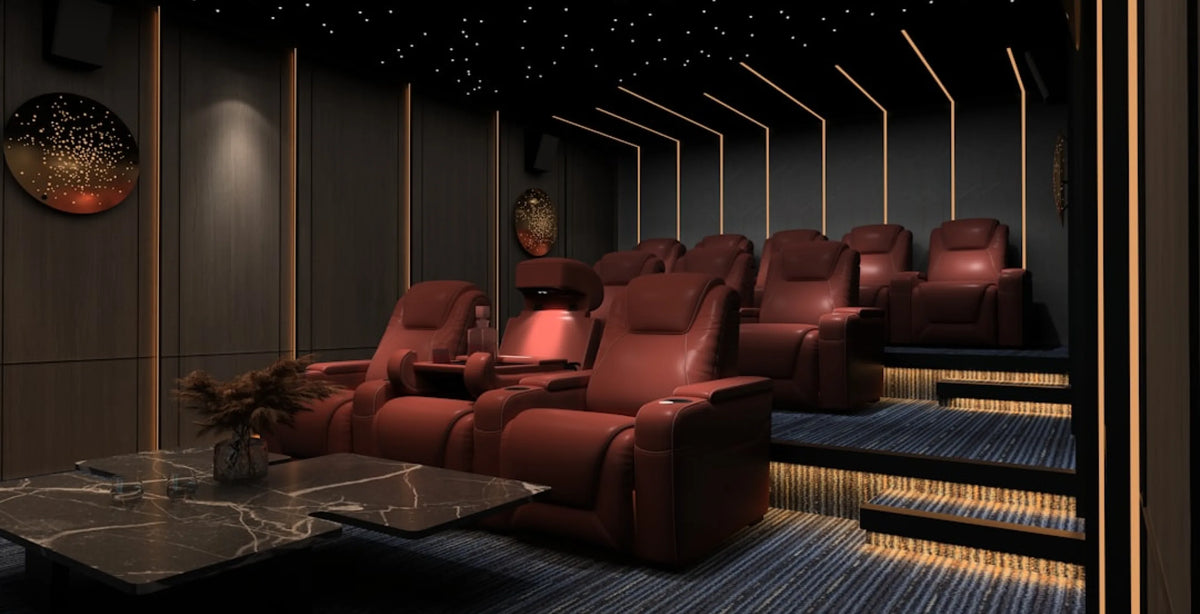
A home theater is a single-purpose room. The goal is to control light and sound as tightly as the budget allows: blackout treatments or no windows at all, walls and ceilings planned with sound treatment, and seating arranged in rows facing one screen, sometimes on a riser so a second row can see over the first. Because the room does nothing else, it can commit fully to the viewing experience in a way a shared living space can't.
Quick check: if the room hosts a birthday party or a Sunday with the in-laws, it's a media room. If its only job is the screen, you're planning a home theater.
Neither term has one fixed industry definition, installers, builders and homeowners use them a little differently, but the practical dividing line is almost always how much the room gives up for the movie experience versus how much it stays part of daily life.
Ask what else the room needs to do before you ask what it should look like.
Media Room vs. Home Theater: At a Glance
The table below lines up the two side by side so you can see where your own room already leans.
| Factor | Media Room | Dedicated Home Theater |
|---|---|---|
| Light control | Some daylight; blinds or curtains for glare | Blackout treatments or no windows |
| Seating | Sofas, sectionals, loveseats, shared seating | Individual reclining rows, often tiered |
| Sound | A soundbar or basic surround setup; shares walls with the house | Dedicated speakers and subwoofer (the speaker for low bass), more sound treatment |
| Multi-use | Family room, game room, guest space, movie nights | Movies and gaming only |
| Typical location | Living room, family room, bonus room | Basement, spare bedroom, converted garage |
| Furniture flexibility | Rearranges easily for other uses | Fixed layout facing the screen |
Neither column is "better," they're built for different households. A family that hosts a lot, has young kids, or only has one large room to spare usually leans media room. A household with a spare basement or bonus room and a strong preference for lights-off, phone-away movie nights usually leans home theater.
Look at your own row in this table first. It usually points to the answer before you've measured anything.
Seating: Sofas and Sectionals vs. Theater Rows
Seating is where the two room types diverge the most, and it's the easiest way to tell which one you're actually planning.
Media room seating favors a sofa, loveseat or sectional, one connected piece that still looks and lives like furniture. The Wilshire Home Theater Modular Chaise Sofa, an Italian leather modular sofa with ottoman options, seats a family for a movie, then works just as well for everyday lounging or guests, without looking out of place next to a bookshelf. Sectionals are built from pieces: a left-side seat, middle seats, a corner seat, then a right-side seat, so check each model's configuration options. Loveseats and paired sofa-and-loveseat sets suit a room with more than one job.
- Browse our Sofas & Sectionals
Home theater seating favors individual reclining rows, 2- to 5-seat configurations with their own armrests and recline controls per seat. A row like the Luminis Zero Gravity Home Theater Seating with Heat & Massage, our best-selling row, adds zero gravity recline (a deep, legs-raised position named after the neutral body posture NASA documented in weightlessness), heat and massage, and a power headrest (a headrest that adjusts at the touch of a button) to that format. Rows also stack into a raised back row behind a front row for a second tier with its own sightline, which a shared sofa can't easily do.
- Browse our Home Theater Seating
Sizing works the same way in both directions. Theater rows in the standard configuration run about 62-86" wide for 2 seats, about 90-126" for 3 seats, and about 117-164" for 4 seats, while sofa and loveseat widths vary by model. Measure your wall before choosing either format, and check the exact width on the product page. If the room needs to still look like furniture, choose a sofa or sectional; if its only job is the screen, choose a row.
Hybrid Rooms: Get Both in One Space
Plenty of real rooms land between the two extremes, and that's normal rather than a compromise. Many are a media room by day, daylight, a sectional, a shared TV, and convert closer to a theater at night with blackout shades and dimmed lighting. That's the most common hybrid, and it works because the furniture doesn't have to change, just the light.
Another option is a two-zone layout: a sectional or media lounge sofa toward the back for casual use, with a theater row or two nearer the screen for dedicated viewing nights.
- Browse our Media Lounge Sofas
Family rooms that already double as a TV room are frequently the starting point for this kind of hybrid. See our guide, TV Room Ideas, for layout ideas that keep a room living-room-friendly while still upgrading the seating and screen. If you're leaning further toward a fully dedicated room instead, our guide to Private Screening Room Design covers the row planning, sightlines and acoustics that come with going all-in on a single-purpose theater.
A hybrid room just needs light control that can change with the time of day.
How to Decide Which to Build
Start with how the room needs to work outside of movie night, because that answer usually settles the rest. If it also has to be the family's living room, a playroom or a guest bedroom, a media room with flexible sofa or sectional seating is almost always the better fit, it never stops being a normal room. A spare room with no other job suits a dedicated theater instead, with reclining rows and a tiered layout.
Budget and construction effort point in different directions too. A media room upgrade is usually just seating, a screen and some light control added to an existing room. A dedicated theater typically means more construction: sound treatment, blackout treatments and sometimes a riser. Screen size and seating distance matter either way, see our guide on how far a couch or row should sit from the TV first.
The takeaway: let the room's other jobs decide the format, then let your budget decide how far you build it out.
Where to Start: 4Seating's Top Media Room Picks
- Wilshire Home Theater Modular Chaise Sofa - an Italian leather modular chaise sofa with ottoman options, built to work as everyday furniture and movie-night seating in the same room.
- Luminis Zero Gravity Home Theater Seating with Heat & Massage - our best-selling row, with zero gravity recline, heat and massage, and a power headrest, for a room whose only job is the screen.
- Anthem LT HeatZero Italian Leather Home Theater Sofa - one of our top-selling sofas, an Italian leather sofa with power recline and a power headrest that still reads as living-room furniture.
- Diamante Movie Theater Sofa for Home Theater - a modular sofa that gives a media room a lounge-style layout instead of a straight row.
If you're still torn, measure your wall length and note how much daylight the room gets, then compare those with each model's Dimensions tab. Shipping on seats and sectionals is free anywhere in the continental US, and sample swatches are available for many upholstery options. Still have a question the product page doesn't answer? Our customer help line is available during business hours at 1-800-407-8665.
About this guide: 4Seating has been selling home theater seating since 1997, including the sofas and theater rows covered here.