Church Seating Guide: Chairs vs. Pews vs. Fixed Theater Seats
Share
Every church seating decision starts with one question: how often will this room change use?
Most sanctuaries choose between three seating types: stacking or interlocking chairs that clear the floor in minutes, traditional wood pews that stay in place, and fixed theater-style seats, which are individual upholstered seats in connected, permanent rows. The right choice depends on how often the room changes use, how long services run, and how the congregation is growing.
If you're on a seating committee, this guide compares the three options on comfort, upkeep and flexibility, and lists what to bring to a seating quote call.
This guide compares all three, then goes deeper on fixed theater-style seating, the option for a dedicated worship auditorium where you want individual cinema-style seats instead of folding chairs or wooden benches.
Church Seating Options: Chairs vs. Pews vs. Fixed Theater Seats
Each option trades flexibility for permanence in a different way. A quick comparison:
| Stacking/interlocking chairs | Traditional pews | Fixed theater-style seats | |
|---|---|---|---|
| Flexibility | Highest: clear the room for weddings, banquets, events | Fixed benches, rarely moved | Low: rows are semi-permanent, but free-standing bases don't require drilling |
| Comfort for long services | Moderate; padded fabric options help | Moderate; some have cushions added | Individual upholstered seats, some with a rocker recline |
| Per-seat repair or replacement | Swap one chair | A damaged pew section is a bigger repair | Seats and bases are replaceable per seat or per row |
| Capacity per linear foot | Efficient with tight interlocking | Efficient on long, unbroken benches | Moderate: rows of 2 to 6 with defined seat widths |
| Cleaning | Spot-clean each chair | Wood surfaces, harder to deep-clean | Wipe-clean vinyl or spot-clean fabric, seat by seat |
| Typical use case | Multi-purpose halls, church plants, rented spaces | Traditional, historic sanctuaries | Dedicated worship auditoriums |
Stacking or interlocking chairs make the most sense for a multi-purpose hall that hosts a Sunday service, a Wednesday potluck and a Saturday wedding in the same space, since the floor clears in minutes. The more your room changes use week to week, the more flexibility should outrank permanence.
Traditional wood pews suit a sanctuary that values permanence and historic character over flexibility, a look many established congregations aren't looking to change.
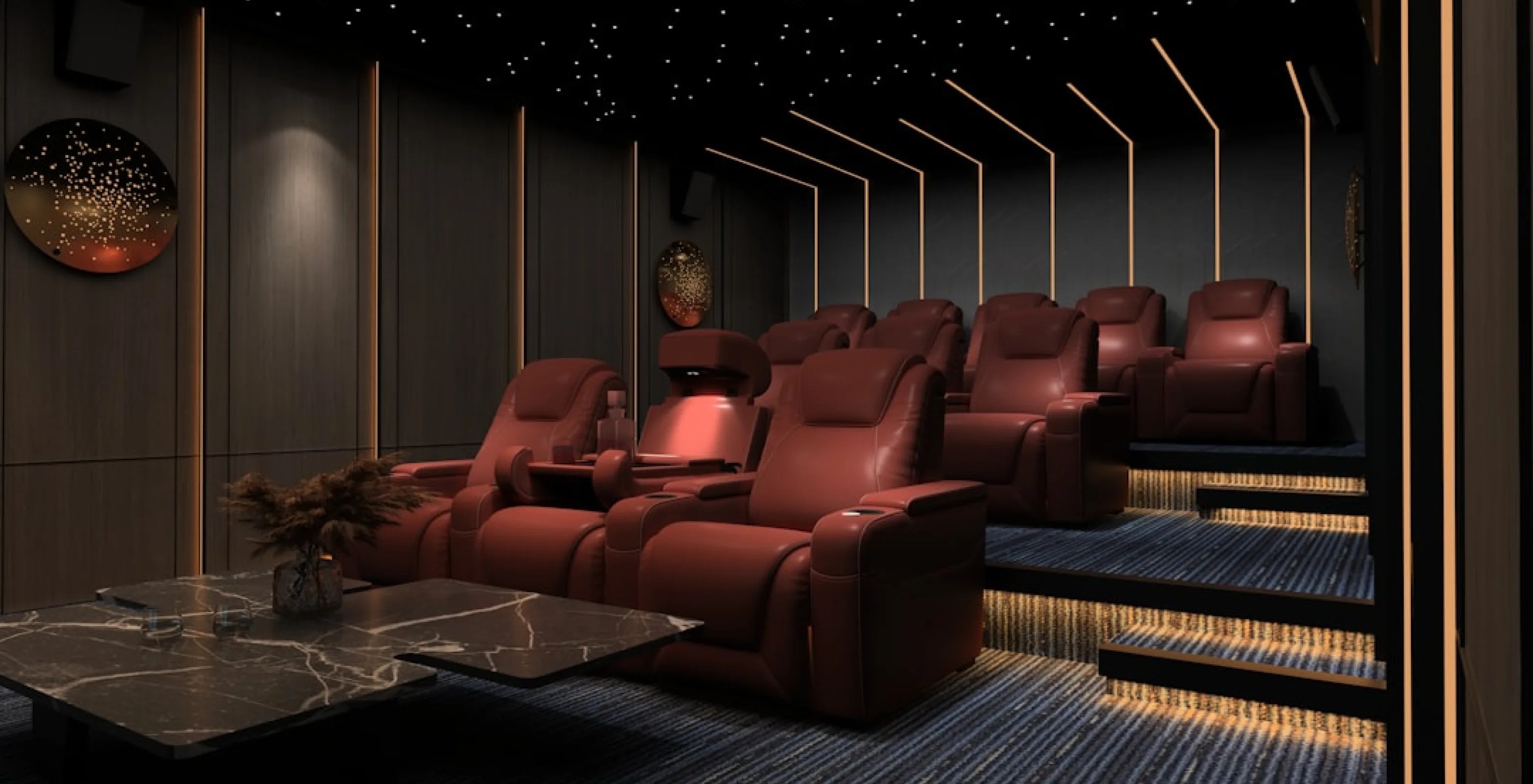
Fixed theater-style seats fit a room committed to worship alone: individual upholstered seats, some with a gentle rocker recline, arranged in rows on free-standing or bolt-down bases. They cost more to install than folding chairs and reconfigure less easily than either alternative, but they bring a finish closer to a real auditorium than a room full of chairs.
Folding and stacking chairs are a different category from the commercial movie seats covered here. If your sanctuary needs to convert to open floor space regularly, start with chairs; if the room is dedicated to seated worship, keep reading.
Capacity and Layout Planning
Start with your row width, then work back to seat count and row count for the room. Commercial movie seats in a row of 3 are about 72" to 78" wide, depending on the model: 74.5" on the Seatcraft Montago and Madrigal, 77" on the Maximus, 78" on the Vanguard and 72" on the Mirage (49" for a row of 2). Check the width of the exact row size on the product page.
Rows of 4, 5 and 6 are listed too, so a long sanctuary row is possible. For widths on bigger rows, check the configuration options on each product page. Multiply by how many rows your sanctuary's depth allows, after leaving room for aisles.
Aisle layout is as much a worship-flow decision as a safety one. A single center aisle suits processions, altar calls and baptisms that move down the middle. Two side aisles, with a wider center section, fit more seats per row and let ushers reach each seat without crossing the room. Walk your sanctuary's expected traffic in your head, a procession, a baptism, a full house filing out after the service, before you lock in a layout. It's easier to change on paper than after the rows are bolted down.
Whichever layout you choose, seat count, aisle width and accessible seating positions are building and fire code questions that depend on your room and your location. The International Code Council publishes the International Building Code, a model code that local jurisdictions adopt and sometimes amend, so check with your local code official or architect before finalizing a seat count. This guide covers general planning only, with no code figures.
A tiered layout, a small elevation change between rows, helps seats further back see the platform. 4Seating's riser packages, built around models like the Seatcraft Montago row riser package and the Madrigal, bundle rows with 7" and 14" riser platforms, a simpler way to add tiering than building custom risers. The Montago 3-row package is 77" wide with 3 seats per row, 106" with 4, 130" with 5 and 154" with 6, and 115" deep front to back. Ask your code official what a tiered floor needs in your building. Let your row width set your seat count, and let your code official set your aisle width.
Materials and Upkeep
A sanctuary seat gets used every week by a wide range of body types and a fair amount of coffee-hour spillage. Two upholstery types cover most of what a weekly-use room needs: commercial vinyl and fabric.
Vinyl, used on the Seatcraft Montago, Madrigal and Maximus, wipes clean, which makes it the easier choice for a room with a coffee bar or fellowship-hall crossover use. Fabric, including the fixed-back Seatcraft Mirage, spot-cleans and gives a softer, more traditional auditorium feel that some congregations prefer over vinyl's shinier look. The black polyurethane Seatcraft Britton sits between the two: a wipe-clean surface with a slightly different texture and a True Rocker back.
Base type matters too. Free-standing rows connect to each other without drilling into the sanctuary floor, which helps if your building is leased, historic, or might change layout down the road. Bolt-down rows anchor permanently, the traditional way to install rows meant to stay put.
- Browse our Free-Standing EZ-Base Movie Seating
Committees watching the budget sometimes look at secondhand inventory instead of new rows. If that's on the table, our guide to buying used movie theater seats covers what to check on a used row before a committee signs off.
Sample swatches are available for many upholstery options, so you can check the vinyl and fabric on your shortlist in person. A swatch in the room, under your actual lighting, settles more debates than a photo on a screen. Let how your building is held (owned, leased, or historic) decide the base, and let a real swatch decide the finish.
Accessibility
Accessible seating, meaning wheelchair positions, companion seats and clear aisle paths, belongs in the layout plan from the first sketch, not after the rows are ordered.
Free-standing rows make it easier to leave an open wheelchair position exactly where your committee wants one, since nothing is drilled into the floor. Bolt-down rows need that position decided before installation.
How many accessible positions your seat count needs, and what ramp and route rules apply, are set locally and vary by building. Consult your architect, general contractor or local code official, using the ICC link above as a starting point, then check each model's Dimensions tab so the positions you've been told to plan for fit into a row plan without losing sightlines.
Getting a Quote
Ordering church sanctuary seating from 4Seating starts on the product pages: pick a model, check its Dimensions tab for row widths, and choose your row size and upholstery.
Warranty is worth asking about before the vote. Seatcraft's 1-year limited warranty and the optional 5-Year Accident Protection Plan both cover seats in a home, not a church or other commercial install, so call 4Seating at 1-800-407-8665 to ask what coverage applies before you buy.
- Browse our Bolt-Down Movie Seats
Seats arrive for assembly, so measure narrow stairwells and tight fellowship-hall doors before you order. For a deeper look at how rows, aisles and tiering work together at auditorium scale, see our auditorium seating guide.
Every seat in your order ships free anywhere in the continental US. Questions left after all that? Our customer help line can help during business hours at 1-800-407-8665.
About this guide: 4Seating has been selling theater seating since 1997, including the commercial theater seats covered here.