Auditorium Seating Guide: Types, Layouts & What to Specify
Share
Start with the room, not the chair. The seats you choose need to handle weekly use, get people in and out of the aisle quickly, and give each row a clear view of the screen or stage.
Auditorium seating, sometimes just called auditorium chairs, falls into four working styles: fixed-back chairs, rocker chairs that lean back a few degrees, free-standing or bolt-down base seats, and tiered rows built on risers. Which one fits your room depends on your floor, how much traffic moves through the aisles, and whether the seating needs to stay put or move again later.
We'll walk through how the four styles differ, how to plan row width, and what to bring to a request for quotation (RFQ), the written list of seats and details a supplier prices from.
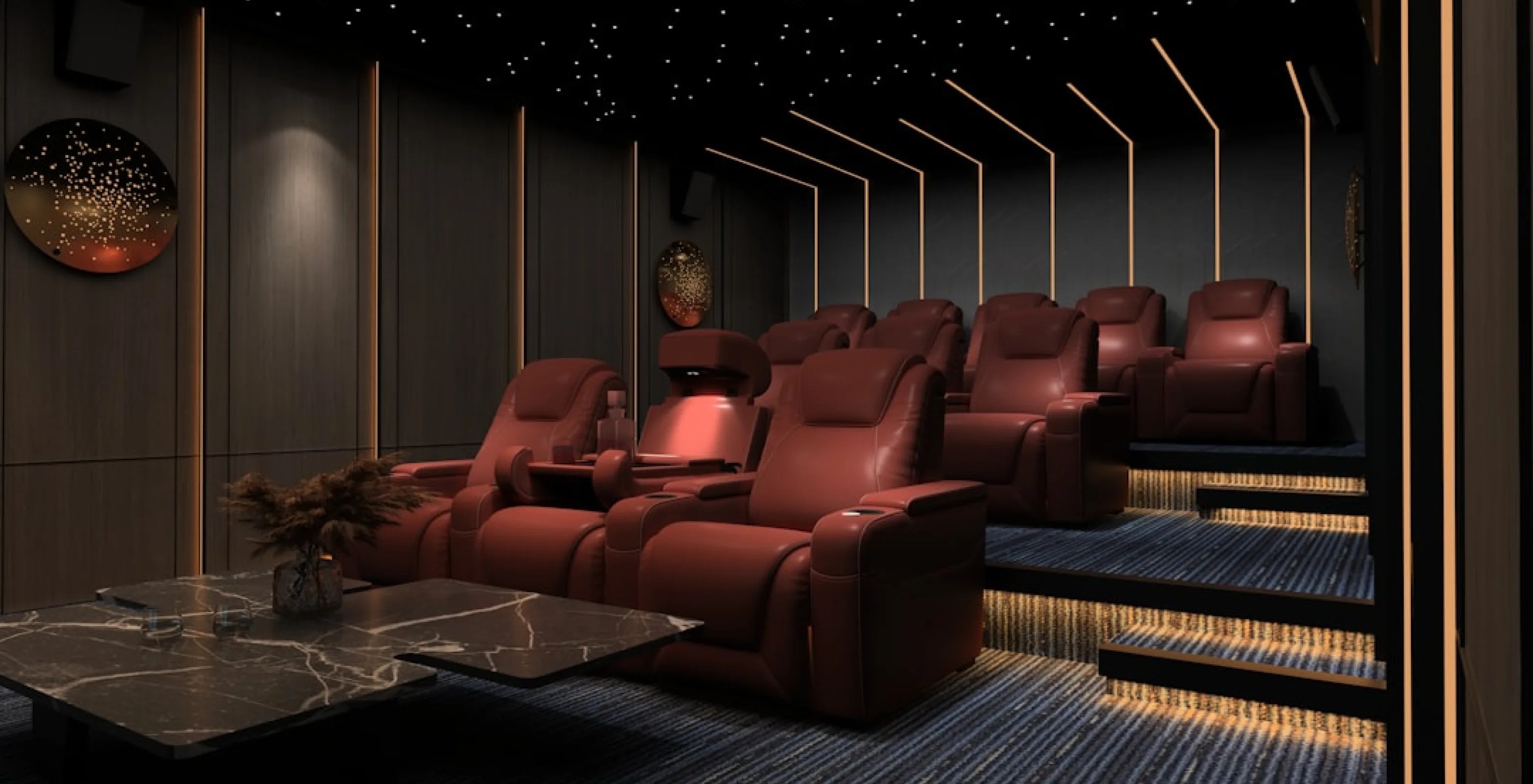
4Seating's commercial movie theater seating collection covers the four styles below, in rows of 2 to 6 seats.
Types of Auditorium Chairs: Fixed, Rocker, Free-Standing & Tiered
Most auditorium decisions come down to two separate questions: how the seat behaves, and how it's mounted. The table below keeps those apart.
| Type | How it behaves | How it mounts | Good fit for |
|---|---|---|---|
| Fixed-back | Stationary backrest, no recline | Bolt-down | Rooms that want a simple seat, high-turnover venues |
| Rocker | Leans back a few degrees; some models have a self-rising seat that lifts when you stand | Free-standing or bolt-down | Rooms that want a cinema feel without full recline |
| Free-standing (EZ-base) | Same seat mechanisms as bolt-down models | No floor drilling; bases connect into a row | Rented spaces, finished basements, rooms that may be reconfigured |
| Tiered / riser package | Rocker seats set on stepped platforms | Bolted to riser deck | Multi-row rooms where each row needs a clear sightline |
Fixed-back seats are the simplest of the four: the backrest stays put, so there's no recline mechanism to maintain. The Seatcraft Mirage works this way, with a molded-foam seat cushion and an easy-clean outer shell.
Rocker seats add a few degrees of recline for a more relaxed viewing angle than a fixed-back chair gives. On models like the Montago and Zenith, the seat pan also lifts itself back up when you stand, the same self-rising action you'd see in a commercial cinema, which helps keep aisles clear between showings.
The Seatcraft Britton takes rocking further with a True Rocker back that swings to a 10-degree angle, paired with a fixed bucket seat cushion and swivel tray tables on its product page. Stationary, a few degrees of rock, or a full 10-degree swing: that covers most of what "seat style" means here.
Base type is a separate decision. Free-standing (EZ-base) seats bolt to a base plate instead of the floor, and the bases link into a row with no drilling, which matters in a rented venue or a basement floor you don't want to damage. Bolt-down seats anchor directly to the floor, the traditional fixed-auditorium install, for a room where the layout is set for good.
The Montago, Zenith and Madrigal are sold both ways. The Mirage, Maximus and Vanguard are listed as bolt-down. Either way, the product pages sell seats as connected rows of 2 to 6, so start with a row of 2 or 3 and add more if the room allows.
For multi-row rooms, a riser package raises each row above the one in front of it. 4Seating's Montago 3-row riser package and its Madrigal counterpart tier a floor platform, a 7" riser, and (on the 3-row package) a 14" riser with a step, with 3 to 6 seats per row. A 3-row package with 6 seats per row seats 18 people. On the Montago 3-row package, the overall width is 77" for 3 seats per row, 106" for 4 (two 53" sections), 130" for 5 (77" plus 53") and 154" for 6 (two 77" sections). Depth front to back is 115" for all three rows: a 23"-deep floor platform, a 46"-deep 7" riser and a 46"-deep 14" riser with a step.
Seating a house of worship instead? The seat-versus-pew trade-offs are different, so see our church seating guide.
- Browse our Stadium Movie Seat Packages
Free-Standing vs. Bolt-Down: Which Mount Do You Need?
Choose free-standing if the floor can't be drilled, the room is leased, or the layout might change down the road. Choose bolt-down for a permanent install in a room built for the purpose.
If the layout and purpose will stay the same for years, bolt-down suits you. If rows might move, free-standing keeps that door open, and the floor and the lease usually settle the question before the chair does.
- Browse our Free-Standing EZ-Base Movie Seats
- Browse our Bolt-Down Movie Seats
Layout Basics: Rows, Aisles & Sightlines
Answer: Auditorium seating layout comes down to three things: row width, row-to-row spacing, and aisle width. Row width comes from the product pages. The other two belong to your local code official, not the seat manufacturer.
Commercial movie seats in a row of 3 run about 72" to 78" wide, depending on the model. Here's what the product pages list:
| Model | Listed row width |
|---|---|
| Seatcraft Mirage | 72" for a row of 3 (49" for a row of 2) |
| Seatcraft Montago, Zenith and Madrigal | 74.5" for a row of 3 |
| Seatcraft Maximus | 77" for a row of 3 |
| Seatcraft Vanguard | 78" for a row of 3 |
Check the exact width of the row size you choose on its product page, since the width changes with the seat count. To see if a row fits your wall, add the row width to the aisle space you plan at each end and compare the total to your wall width.
Aisle and row-to-row spacing are where a code review matters most. Center aisles, side aisles, accessible seating locations and the clearance between rows are building and fire code questions, and the answers change with your venue and location. The International Code Council publishes the International Building Code, a model code that local jurisdictions adopt and sometimes amend, so your local code official has the final word. Plan that layout with your architect or code official first, then check row widths against it on each product page.
Sightlines are the other reason multi-row rooms use risers instead of flat rows: without a raised platform, the heads in front can block the screen. The Montago and Madrigal packages pair a 7" riser with a 14" riser and a step, which raises each row above the one ahead. Your code official decides what a tiered floor needs in your building.
Materials: Vinyl, Fabric & Polyurethane
Upholstery in this collection runs three ways, each answering a different question about how the room gets used.
Vinyl (Montago, Madrigal, Maximus) wipes clean, which suits snack-heavy, high-traffic venues. Fabric (Zenith, Mirage, Vanguard) gives a softer, more traditional auditorium feel but needs more care around spills. The Britton is polyurethane, which also wipes clean.
None of these seats is leather. If a leather look matters, compare the upholstery options on each product page before you spec a full order. Choose by how messy the room gets, not by how it looks in a photo.
What to Specify in an RFQ (Checklist)
A clear RFQ saves rounds of back-and-forth. Have these ready before you order:
| Spec to include | Why it matters |
|---|---|
| Total seat count and seats per row | Rows are sold as connected units of 2 to 6 seats; this sets how many rows you need |
| Number of rows and whether they're tiered | Determines flat rows vs. a riser package, and how many risers |
| Mounting type | Free-standing (no drilling) vs. bolt-down (permanent) changes install time and floor prep |
| Upholstery and color | Vinyl, fabric or polyurethane in the colors each model offers |
| Aisle and accessible-seating plan | Set with your architect or local code official first, then fitted to your row layout |
| Warranty and coverage | Ask what applies to a commercial install |
| Room dimensions (wall width, depth, ceiling height for risers) | Confirms the layout fits before you order |
| Delivery access (loading dock, stairs, elevator) | Affects delivery scheduling for larger orders |
| Install preference | White-glove delivery, which a local agent schedules, is an option beyond curbside |
Want to check color and texture before committing to a full room? Sample swatches are available for many upholstery options. For a venue-scale order, you can call 1-800-407-8665 to place it by phone. Budgeting a full venue build, not just the seats? Our guide to the cost of building a movie theater covers the rest.
Coverage is the last item to settle. Seatcraft's 1-year limited warranty and the optional 5-Year Accident Protection Plan both cover seats in a home, not commercial use, so call 4Seating at 1-800-407-8665 to ask what coverage applies to an auditorium install before you order.
Any seat you add to your cart ships free within the continental US, commercial movie seats included. If you still have questions, our customer help line can support you during business hours at 1-800-407-8665.
About this guide: 4Seating has been selling theater seating since 1997, including the commercial movie seats covered here.