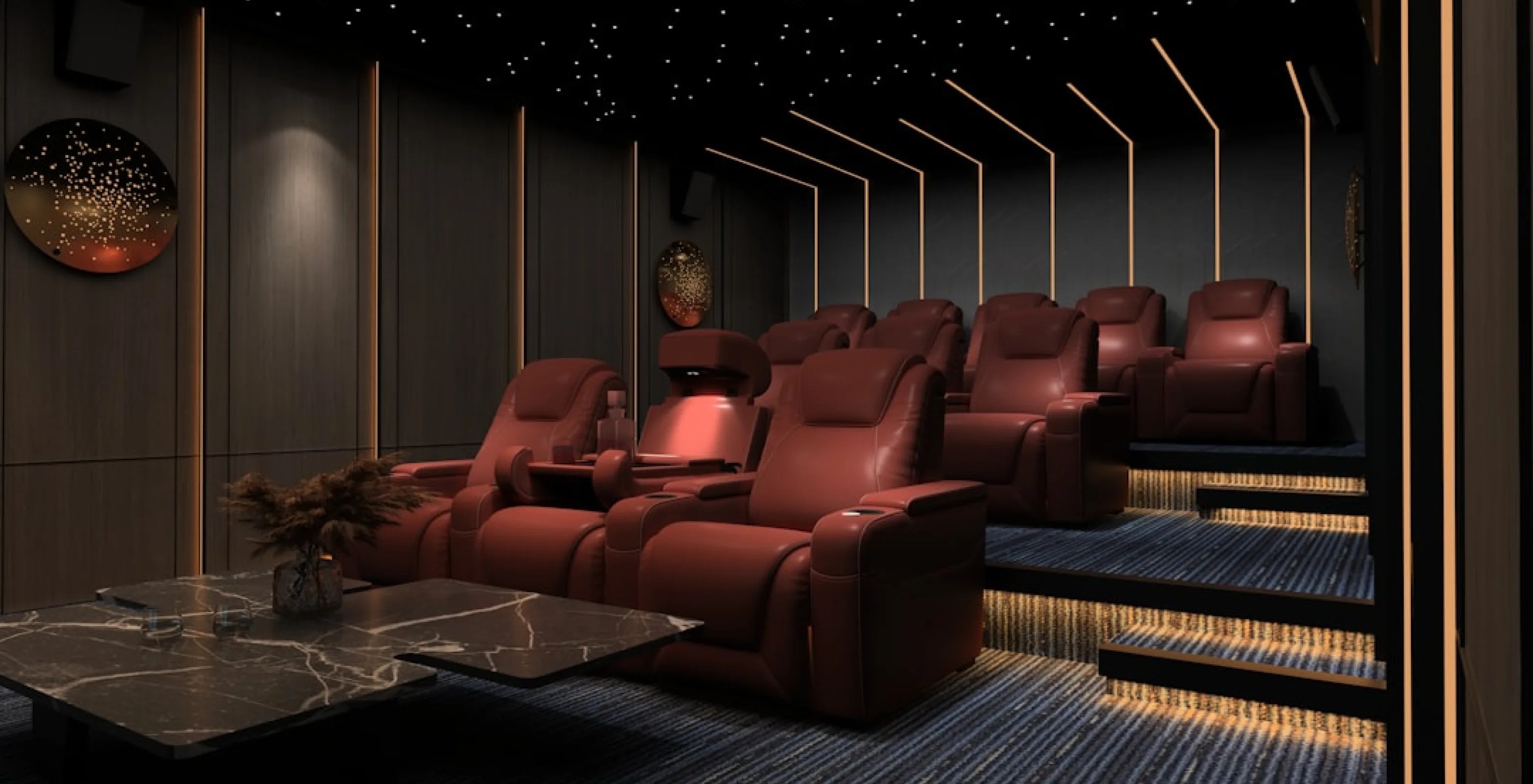
Home Theater Lighting Ideas: Sconces, Step Lights & Star Ceilings
The lights go down before a movie: a soft glow under the seats, a faint field of stars overhead, and just enough light along the steps that nobody stubs a toe on the way to the back row. That's good home theater lighting, and it comes from three layers, not one fixture.
Most good home theater lighting ideas boil down to three layers: dim, warm ambient light for the room's base brightness, low path light along steps and aisles so people can see where they're going, and accent light (seat baselights, sconces, a star ceiling, bias light behind the screen) for mood. Get the first two layers right, then accent lighting is where the room gets its personality.
This guide shows which layer to tackle first, which accent pieces are listed on 4Seating's product pages, and which parts of the job belong to a licensed electrician.
4Seating's home theater decor collection includes fiber-optic star panels, acoustic wall panels and riser platforms. Ambient and path lighting, and anything that touches your home's wiring, are separate projects to plan with a lighting professional and a licensed electrician.
How to Layer Home Theater Lighting: Ambient, Path and Accent
Think of the three layers as separate jobs, not separate rooms. Ambient light sets the base brightness you dim down right before the movie starts. Path light is functional: low, steady light that keeps steps and aisles visible once the ambient layer goes dark. Accent light is the decorative layer, and it's what makes the room look like a theater instead of a dark basement.
| Layer | Job | Typical fixtures | When it's on |
|---|---|---|---|
| Ambient | Base room brightness | Ceiling cans, wall wash, dimmable overheads | Full during setup, dimmed to near-dark for the movie |
| Path | Visibility on steps and aisles | LED strip along riser edges, low rope lights, floor pucks | Low, once ambient dims |
| Accent | Mood and decor | Seat baselights, sconces, star panel, screen bias light | Dimmed for the movie, brighter between showings |
To find your path-lighting gap, stand at your main doorway with only the overhead lights on, then dim them. If you can't tell where the steps or aisle edges are, fix that before you touch the decorative layer.
Ask your electrician about putting each layer on its own switch or dimmer. A "theater mode" that dims the ambient light while leaving path and accent lighting on is the easiest way to get a dark room that's still easy to walk around in. Fixtures and dimmers are a job for a licensed electrician.
Seat Baselights and Cupholder Lights
Some of 4Seating's home theater seating lists LED baselighting and LED cupholders on its Specifications tab: small, low-glow accents under the seat base and inside each cupholder that stay lit, dimmed, while the rest of the room goes dark. On those models, it's an accent layer that comes with the seat itself instead of something you add afterward.
The Luminis Zero Gravity Home Theater Seating with Heat & Massage, our best-selling row (sold as the Luminis LT Plus), lists "Baselighting: Yes, 7-Color LED Lighting" and a 7-color LED cupholder. If you're building your room's lighting around this layer, that gives you seat-level accent light as part of the seat. Lighting features differ by model, so check each product page's Specifications tab before you plan the rest of the room around it.

If you're starting from scratch, choosing a row with baselights listed on the spec means one less lighting layer to plan separately.
- Browse our Home Theater Decor
Step and Riser Lighting
Path lighting matters most at a level change. A riser is a raised platform that lifts a back row so everyone sees over the row in front, and its edge is an easy place to misjudge a step once the lights go down. That makes step and riser lighting a visibility layer first, decor second.
A continuous LED strip along a riser's front edge, set low and dim, outlines the step clearly without throwing light up into the room. The SoundRight 14" Home Theater Riser Platform doesn't list lighting on its spec, so a strip is something you'd add separately; ask your electrician how to power it. Mount path lights low on the wall or along the step so they mark the edge without glaring toward the screen.

Local code can set requirements for steps and lighting in some spaces, so check with your building department before you finalize a plan. The International Code Council publishes the International Building Code, but your jurisdiction decides which edition and amendments apply.
4Seating's home theater risers come in 7" and 14" heights.
- Browse our Home Theater Risers
Sconces and Dimmers
Wall sconces are a popular home theater lighting idea, and for good reason. Pointed down or sideways rather than out into the room, they add warm ambient light without putting a bare bulb in anyone's line of sight.
Sconces are a lighting-fixture category of their own, so plan them alongside your electrician and any lighting professional you work with. Any new wiring for a sconce or a dimmer is electrical work, and that's a job for a licensed electrician, not a weekend project.
A few placement basics carry across most rooms:
- Put sconces on their own dimmer, separate from any ceiling or can lighting, so you can bring them down to a warm glow during the movie and back up between showings.
- A common guideline is to mount sconces about 60 to 70 inches from the floor, around standing eye level (This Old House). Sit in your seats and check how the fixture looks from there before you commit, and choose one that directs light up or down rather than at the audience.
- Choose warm light. Color temperature is measured in kelvins (K), and lower numbers look warmer. For homes, about 2,700K (warm) to 3,000K (soft) is the usual range (U.S. Department of Energy), rather than a bright white that competes with the screen.
Warm and low beats bright and direct in a room built for a screen. Two or three sconces spaced along a side wall, dimmed low, can give a room more atmosphere than a single bright fixture.
Star Ceilings: Fiber-Optic Panels for a Starry-Sky Look
A fiber-optic star ceiling is one of the most eye-catching lighting ideas for a home theater, and 4Seating lists one on its product pages: the SoundRight Fiber-Optic Star Panel. Fiber-optic means thin strands that carry light from a single source to many small points, which is what creates the "stars."

The product page describes the panel as designed for easy installation, and it links installation and connection guides, so read those before you plan the ceiling. Check the page for the panel's size, colors and configuration options, and see the star panels collection for other styles. Anything that connects to your home's wiring is a job for a licensed electrician.
- Browse our Fiber-Optic Star Panels
Bias Lighting Behind the Screen
Bias lighting is a low, even strip of light placed behind the screen or TV, facing the wall rather than the room, so your eyes aren't jumping between a bright screen and a pitch-black surround. It's designed to soften the contrast between the screen and the wall without raising the room's overall brightness.
Bias lighting kits are typically an LED-strip purchase from an electronics or lighting supplier. Keep the light dim and neutral to warm in color, and make sure it isn't visible past the screen's edges. The goal is a softer transition, not a second light source the audience notices. Ask your electrician before you plan how it's powered.
Which Lighting Elements Are on 4Seating Product Pages, and Which You'll Plan Separately
| Lighting element | On a 4Seating product page | What you'll typically plan separately |
|---|---|---|
| Seat baselights and cupholder lights | Listed on the Specifications tab of some seating models, such as the Luminis | Nothing extra for the seat itself |
| Fiber-optic star ceiling | SoundRight Fiber-Optic Star Panel | Mounting and connection, with a licensed electrician where wiring is involved |
| Riser edge / step lighting | SoundRight risers (lighting isn't on the spec) | LED strip lighting along the riser edge |
| Sconces and dimmers | Separate category | Fixtures and dimmer switches, installed by a licensed electrician |
| Bias lighting behind the screen | Separate category | An LED strip kit, powered as your electrician advises |
Anything that touches your home's wiring is a licensed electrician's job.
Where to Start: 4Seating's Lighting-Ready Picks
- SoundRight Fiber-Optic Star Panel - a star ceiling panel with installation and connection guides on the product page.
- Luminis Zero Gravity Home Theater Seating with Heat & Massage - our best-selling row, with LED baselighting and LED cupholders on the spec.
- SoundRight 14" Home Theater Riser Platform - a 14" riser for a back row, with an optional riser step; add path lighting along its edge separately.
Shipping covers the continental US, and the seats you add to the room ship free. Contact the team for sample swatches of the seating upholstery. If anything is still unclear, call our customer help line during business hours at 1-800-407-8665.
About this guide: 4Seating has been selling home theater seating since 1997, including the LED-lit theater seats covered here.