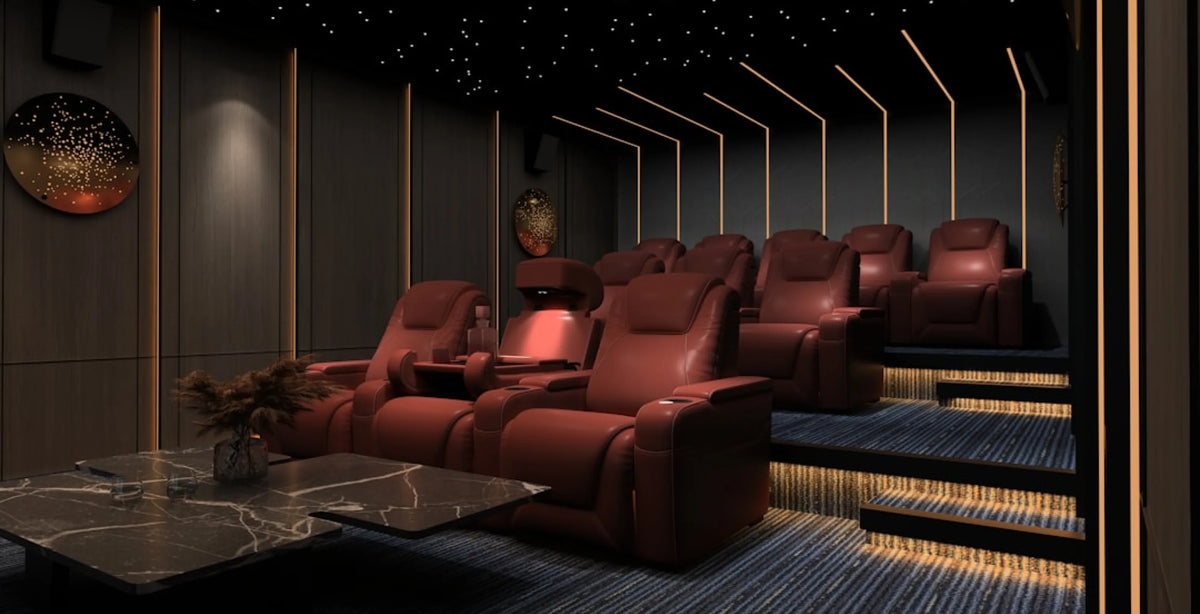
12 Home Theater Seating Ideas for Every Space & Budget
A home theater seating idea only works if it fits the room you actually have, not the catalog page. A wallhugger loveseat suits a small apartment den. A curved leather row suits a dedicated theater built to host a crowd. A reclining sectional suits a family media room that has to double as a hangout space most days of the week.
Below are 12 home theater seating ideas and home movie theater seating ideas, each tied to a real room type, a real budget, and a real 4Seating collection.
How wide is the wall you're facing seating toward, and who's usually on the couch with you? Keep those two answers in mind as you browse the full range of home theater seating to compare rows, sofas, and feature levels side by side.
1. Small Home Theater Seating Ideas: Wallhugger Loveseats and SpaceSaver Recliners
Got a spare bedroom or an apartment corner, with a TV on one wall and only a few inches to spare behind the seating? That's the room a loveseat or a compact, wall-hugging recliner was built for, the starting point for most small home theater seating ideas.

A loveseat skips the center armrest, so two people sit closer without losing a seat to furniture in between. Two terms help here. A wallhugger is a seat that needs very little space between its back and the wall when fully reclined. A SpaceSaver has narrower armrests, which trims the width of the whole row. The Sienna Italian Leather Spacesaver Home Theater Seating is both: it needs 3" from the wall to fully recline. Measure the wall and doorway width before you order.
This suits a studio, a den, a bonus room, or anyone whose "theater" is really a corner of a shared space. See our guide on small-room home theater ideas for layouts and seat counts. In a room this size, the depth behind the seat matters more than floor space.
2. First Home Theater on a Starter Budget: Affordable Rows
The first row you bring into a house is usually simple: plain upholstery, a straightforward recline, a cupholder for the popcorn. That's already enough to make a spare room feel like a real theater, without a fully loaded model's price tag. Pick the features that matter most to you and leave the rest for the next row.
This suits a first dedicated row, or a guest room doubling as a media room. Heat, massage, and power headrests can wait.
3. Dedicated Theater Room: Premium Leather Recliner Rows
If your room holds nothing but the screen and the row, with no coffee table to work around and nothing competing with the screen, that's where full-feature rows earn their keep: Italian leather upholstery, power recline, adjustable power headrests that tilt at the touch of a button, power lumbar (an adjustable lower backrest cushion), and USB charging, depending on the model.

This suits a household committed to the room staying a theater, not doubling as a playroom or office, so load up every feature here; nothing else in the room competes for that budget.
4. Modern Media Room: Sleek, Low-Profile Seating
If your media room opens straight into the kitchen and is visible the moment guests walk in, a classic recliner's tall headrest and exposed hardware can look out of place. Look for a slimmer profile, cleaner lines, neutral hues, and low headrests instead, so it reads as furniture first and theater seating second.
This suits an open-concept, contemporary home where the "theater" has to look like it belongs with the rest of the house. In a visible room, the seat's profile matters as much as its recline.
5. Movie Marathons and Long Gaming Sessions: Zero-Gravity Recline
Three episodes into a weekend binge, or hour four of a gaming session, you've stopped noticing you're sitting at all. Zero-gravity recline is made for those evenings: one button lifts your legs and eases the back down into a deep lounge position you can settle into for hours.
Our Luminis Zero Gravity Home Theater Seating with Heat & Massage, our best-selling row, pairs zero-gravity recline with heat and massage.
This suits anyone who holds one position for hours rather than shifting around. See our guide to zero-gravity home theater recliners for the full picture. If you measure movie nights in hours, not minutes, zero-gravity recline is the feature to look at first.
6. Curved Theater Seating Ideas for Wide Rooms and Big Gatherings
In a wide room, the end seats of a straight row end up pointing toward the side wall instead of the screen. A curved row, built with wedge-shaped consoles between seats, angles the outer seats toward the center.
This suits a room built to host game day or a full house on movie night, where nobody should end up in the "bad seat." If your room is wider than it is deep, a curved row keeps the outer seats pointed at the screen.
7. Media Room Seating Ideas: Reclining Sofas and Sectionals for the Family Room
Tuesday afternoon, the room is couch-style togetherness; on movie night, it's individual recline and cupholders. A reclining sofa or sectional does exactly that, and L-shaped or U-shaped, modular layouts fill an odd-shaped room and rearrange as your family's needs change.
This suits a household where the "theater" never stops being the living room, kids, pets, and all. Browse sofas and sectionals built with theater features like power recline.
A sectional lets one room be the family room and the theater, without forcing a choice between them.
8. Cozy Den or Date-Night Room: Loveseats Without a Center Console
Sharing a blanket with nothing between you but armrest? A loveseat is two seats with no console in the middle, the natural pick for a couple, or a parent and a kid, with a recline on each side.

This suits a smaller den or reading nook, anywhere the point is sitting together, so skip the console when closeness matters more than a spot for a drink between you.
9. Casual Streaming Lounge: Chaise-Style Lounge Recliners
A chaise-style recliner works like an ottoman you never have to drag over, because the footrest is already built into the chair. With an extended footrest, these recliners read as relaxed rather than formal, suiting a casual streaming setup or a reading nook that doubles as a screen room. A chaise recliner fits a room built around comfort first, structure second.
10. Winter Movie Nights: Heat and Massage Seating
Cold night, you come in and settle into a seat that's already warm. Heat and massage turns an ordinary movie night into a small event, warmth and a massage cycle layered onto full power recline.
This suits a room that gets heavy use in cold months, or anyone who wants the seat to do a little more than recline. Heat and massage pay off fastest in a room you actually use through winter.
11. Two-Row or Stadium-Style Theaters: Elevated Back Row Seating
The goal in a second row is simple: everyone still sees the whole screen, not the back of the head in front of them. A construction riser platform is the traditional fix, and SoundRight risers come in 7" and 14" heights. BACKROW seating skips the platform: the seats sit taller themselves, about 6 to 8.5" taller than a standard row of the same model, depending on the model, so the second row gets a clear sightline on a flat floor. Want more clearance still? Pair BACKROW with FRONTROW seats up front. They sit lower than standard seats, though they may lack some features.

This suits a dedicated theater adding a second row without a construction project. Browse back row seating if a platform build isn't on your list.
A taller seat and a taller platform solve the same sightline problem, so pick whichever one your ceiling and budget allow.
12. Taller or Larger-Framed Viewers: Big and Tall Seating
If you've ever settled into a recliner only to find the headrest hits your shoulders, not your head, you know the problem. Many regular-size recliners can crowd a taller frame before the recline even maxes out, so Big & Tall seating is simply taller and roomier. The Pantheon Italian Leather Big & Tall Home Theater Seating is rated to 400 lbs per seat.

This suits any household with a taller or larger-framed family member who's been making do with a seat that doesn't quite fit. Browse the Big & Tall seating collection, or see our best recliners for tall people guide for model-by-model picks.
Fit the seat to your tallest regular viewer, not the average one.
How Much Space Do You Need Behind a Reclining Seat?
Good theater seating layout ideas start with two measurements: wall width, then depth behind the seat. Recliners need room to swing the footrest out. Wallhugger models need much less between the seat back and the wall: about 3" to 6.5" across Seatcraft models, such as the Sienna at 3", the Napa at 5" and the Pantheon at 6.5". Open the Specifications tab on any model you like for its number. The Dimensions tab lists Full Recline, the distance from the wall when the seat is fully reclined, so keep tables and walkways beyond it.
Home theater seating rows run about 62-86 inches wide for 2 seats, 90-126 inches for 3, 117-164 inches for 4 and 145-178 inches for 5, so match the row size to your wall. A common guideline is to leave at least 24 inches between furniture and 30-36 inches for main walkways. Power recline models plug into a standard 110v wall outlet, and each seat may need its own, while manual models don't plug in.
| Row size | Width range | Ideas that fit best |
|---|---|---|
| 2-seat row | about 62-86" | Wallhugger loveseats (idea 1), date-night loveseats (idea 8) |
| 3-seat row | about 90-126" | Starter rows (idea 2), full-feature rows (idea 3), curved rows (idea 6) |
| 4-seat row | about 117-164" | Two-row back row layouts (idea 11), Big & Tall rows (idea 12) |
| Sofa or sectional | varies by layout | Family media room (idea 7), casual lounge (idea 9) |
The idea numbers match the section headings above, not a ranking. You don't need to get every number perfect, just these two: your wall width and the depth behind the seat.
Picking by Room and Budget Tier
Think in feature tiers rather than price tags; each tier spans multiple upholstery colors and row sizes.
- Entry tier: manual or power recline (motor setup varies by model), cupholders, leather-gel or fabric upholstery. Good for a first theater or a guest room doubling as a media room.
- Mid tier: power recline, power headrest or power lumbar (not always both), USB charging. Good for regular weekly use.
- Full-feature tier: power recline with power headrest and lumbar together, heat and massage, zero-gravity recline, or both together. Good for a dedicated, frequently used theater.
Pick a tier based on how often the room gets used, not on how it looks on day one.
Where to Start: 4Seating's Top Picks for These Home Theater Seating Ideas
- Sienna Italian Leather Spacesaver Home Theater Seating - the wallhugger and Spacesaver pick for small apartments and any space tight on rear clearance (idea 1).
- Luminis Zero Gravity Home Theater Seating with Heat & Massage - our best-selling row, built for marathons and long gaming sessions with zero-gravity recline, heat, and massage (idea 5).
- Diamante Italian Leather Zero Gravity Home Theater Seating - one of our top sellers, an Italian leather row for a dedicated room (idea 3).
- Diamante FX Flip-Up Headrest Home Theater Seats - a flip-up headrest style for a different look from the regular Diamante row (idea 4).
- Anthem LT HeatZero Italian Leather Home Theater Sofa & Loveseat - a top-selling sofa that makes a family media room feel like a living room (idea 7).
- Kodiak Chaise CoolZero Italian Leather Home Theater Seating - an extended footrest for the casual streaming lounge (idea 9).
Every seat ships free anywhere in the continental US, and sample swatches are available for many upholstery options. You can also place your order by phone, and if you still have questions, our customer help line can help during business hours at 1-800-407-8665.
About this guide: 4Seating has been selling home theater seating since 1997, including the rows, sofas and sectionals covered here.